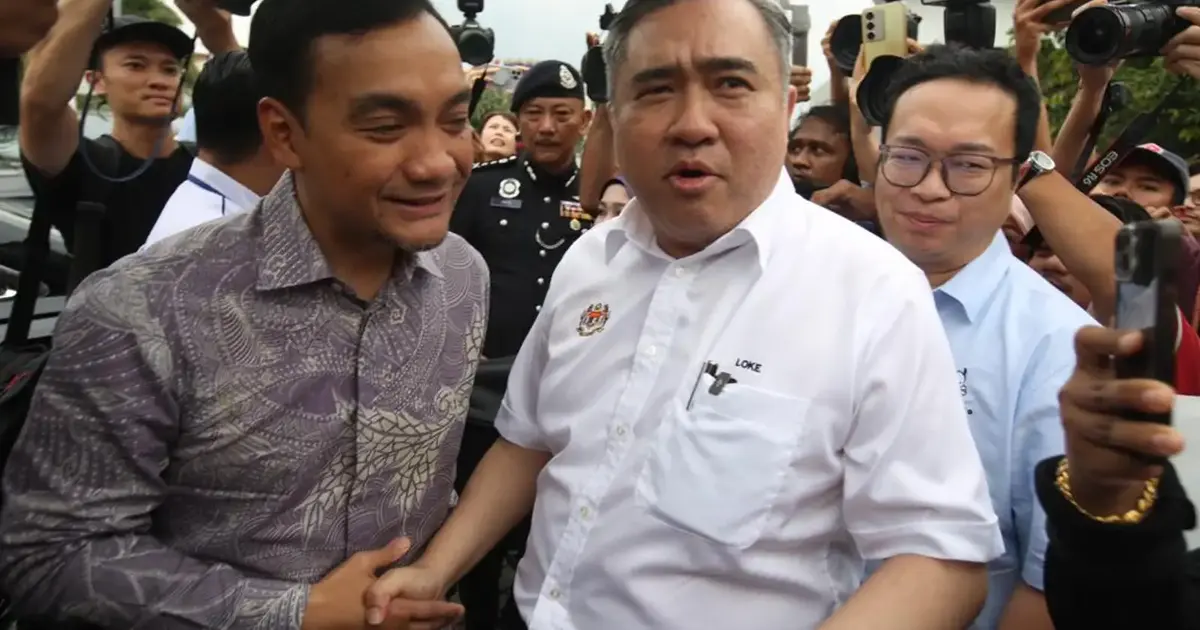
Transport Minister Anthony Loke and Johor Menteri Besar Onn Hafiz Md Salleh came together at an official ministry gathering, demonstrating a carefully calibrated display of political maturity following their recent digital disagreement. The encounter marked their first in-person interaction since the pair engaged in pointed remarks across social media platforms, and the atmosphere proved cordial enough, suggesting both leaders recognised the importance of maintaining decorum in public settings even when relations remain strained.
The event, organised by the Transport Ministry, brought together both figures in a formal setting where political rivalries typically yield to procedural courtesy. Onn Hafiz's attendance required him to adjust his schedule substantially, given the short notice of the invitation. Rather than letting this inconvenience pass unmentioned, the Johor leader used his speech as an opportunity to subtly underline the disruption, though his comments remained wrapped in the kind of diplomatic language expected at official functions.
Onn Hafiz's remarks carried a pointed edge directed at Loke, suggesting that the brevity of the advance notice had necessitated significant rearrangement of his pre-existing commitments. This observation, delivered in a speech setting, functioned as both a factual statement and a gentle rebuke—the kind of implicit criticism that operates within the bounds of acceptable political discourse while still conveying displeasure. The comment exemplified how Malaysia's political establishment frequently conducts disagreements: through careful insinuation rather than outright confrontation during public events.
The earlier online exchange between the two leaders had generated considerable attention within Malaysian political circles and among the broader public following social media discourse. Such digital spats have become increasingly common among senior politicians, who use platforms like Facebook and Twitter to communicate directly with constituents and critics alike. However, the transition from online hostility to in-person civility illustrates the complex navigation required by public officials balancing partisan interests with the institutional expectations of their positions.
The Transport Ministry event itself served as neutral ground of sorts, though Loke's position as minister gave him considerable control over the setting. The fact that the Johor leader chose to attend despite the scheduling challenges suggests both political pragmatism and recognition that boycotting or refusing such invitations would itself constitute a form of political messaging that could damage his standing. For Onn Hafiz, participating demonstrated a willingness to engage across political lines while still maintaining his state-level autonomy and influence.
Their interaction carries implications beyond the immediate personal relationship between two prominent politicians. The Johor Menteri Besar holds significant regional influence within Malaysian politics, overseeing one of the country's largest and most economically important states. Transport and infrastructure initiatives frequently intersect with state-level governance, making constructive relationships between federal and state leaders essential for effective policy implementation. Johor's strategic position within the broader Malaysian economy means that transport decisions made at the national level directly impact the state's development trajectory.
Loke, as Transport Minister within the current federal administration, navigates complex political terrain requiring engagement with Menteri Besar across multiple states. While federal and state governments may operate under different political alignments, the practical realities of governance demand ongoing cooperation. Infrastructure projects, licensing arrangements, and regulatory frameworks cannot function effectively if senior officials refuse to communicate. This necessity creates a structural incentive for maintaining at least working relationships, regardless of electoral competition or ideological differences.
The online dispute between the two leaders reflected broader tensions within Malaysian politics, where coalition politics and state-federal dynamics create frequent opportunities for public disagreement. Social media has amplified these tensions by providing platforms where politicians address each other and their supporters directly, bypassing traditional media filters. The speed and public nature of digital communication mean that such exchanges escalate quickly and reach wide audiences, potentially damaging political relationships and public confidence in institutions.
The recovery to civility demonstrated at the Transport Ministry event suggests both leaders recognised the costs of prolonged public antagonism. Malaysia's fractious political environment has seen numerous instances where personal disputes between leaders inflict collateral damage on government operations and public services. By meeting face-to-face and maintaining courtesy, Loke and Onn Hafiz signalled an understanding that their disagreement, whatever its nature, need not become an obstacle to effective governance.
Moving forward, the dynamic between the Transport Minister and Johor's chief executive will merit close observation. Whether this encounter represents a genuine de-escalation or merely a tactical pause in their dispute will become apparent through subsequent interactions and policy decisions. Onn Hafiz's subtle dig during his speech suggests underlying irritation persists, even if outward relations have stabilised. For observers of Malaysian politics, this episode illustrates the delicate balance senior officials maintain between partisan competition and institutional cooperation—a balance increasingly tested in an era of instantaneous digital communication and public political discourse.