Malaysia's Islamic New Year celebrations for 1448H in 2026 underscored a unifying message about transformation and collective purpose across the nation, with events held countrywide highlighting how the concept of hijrah—spiritual migration and positive change—remains deeply relevant to contemporary Muslim societies seeking stronger moral foundations and purposeful governance.
The overarching theme of this year's Maal Hijrah festivities, "MADANI Dihayati, Ummah Diberkati," centred on the belief that spiritual migration extends beyond historical significance into a modern framework for personal and national development. Rather than merely commemorating the Prophet Muhammad's journey from Mecca to Medina in the seventh century, organisers positioned hijrah as a continuous pathway through which individuals and communities can redirect themselves toward better values, improved leadership practices, and increased social cohesion within the broader Muslim world.
High-level government participation underscored the state's commitment to integrating Islamic principles into national development agendas. Deputy Prime Minister Datuk Seri Fadillah Yusof and Minister in the Prime Minister's Department (Religious Affairs) Dr Zulkifli Hasan attended the main ceremony, signalling executive-level engagement with religious observances and their perceived connection to governance quality. This official presence reflects a broader regional pattern where Southeast Asian governments increasingly acknowledge the intersection between Islamic values and developmental objectives, particularly in nation-building and community trust.
The celebration attracted approximately 5,000 participants and featured traditional spiritual programming including Quranic recitations and scholarly religious discourse. These elements maintain the devotional character essential to Islamic observance while creating space for intellectual engagement with contemporary challenges facing Muslim communities, from ethical leadership standards to societal cohesion amid rapid modernisation.
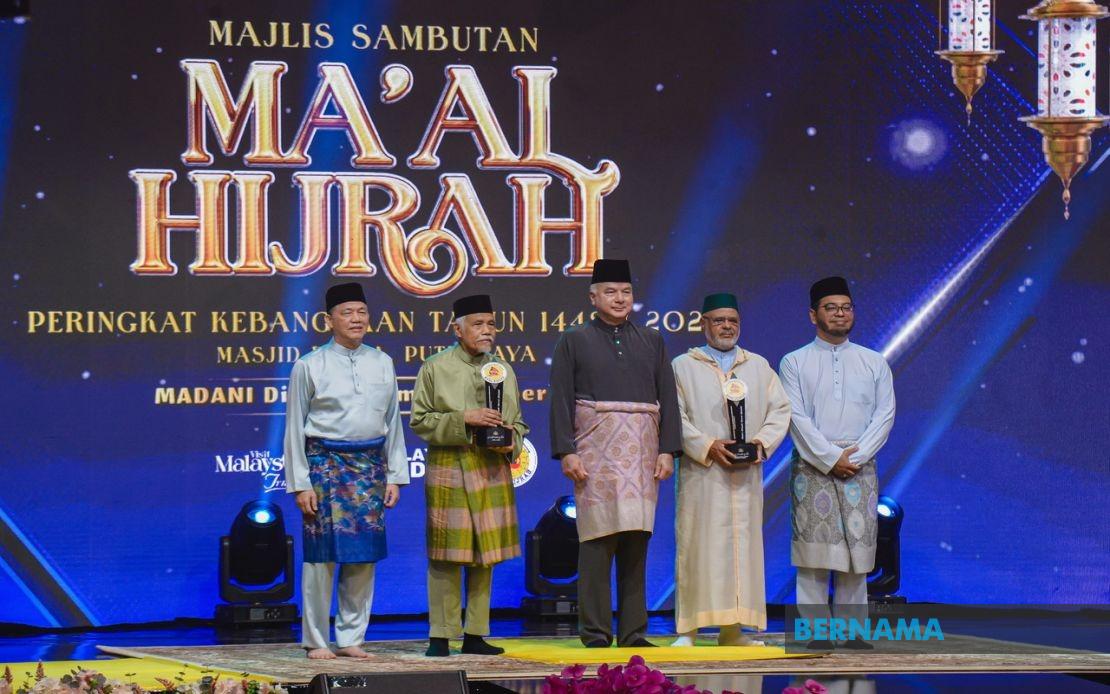
Recognition ceremonies formed a significant component of the day's proceedings, with prestigious awards honouring individuals whose contributions exemplify hijrah's transformative principles. Sultan Nazrin, Sultan of Perak, presented the National Tokoh Maal Hijrah Award to Prof Emeritus Datuk Dr Osman Bakar, rector of the International Islamic University Malaysia, acknowledging academic contributions to Islamic thought and education within Malaysia's institutional framework. The award for Osman Bakar carries particular weight given IIUM's prominence as a regional centre for Islamic scholarship, suggesting that the nation values intellectual leadership within religious contexts.
International recognition expanded the celebration's scope beyond Malaysia's borders, with Moroccan Islamic jurisprudence scholar Dr Ahmad Al-Raysuni receiving the International Tokoh Maal Hijrah Award. This selection reflects Malaysia's positioning as a participant in global Islamic discourse and its interest in recognising scholars contributing to contemporary Islamic jurisprudence across different regional traditions and schools of thought.
At parallel celebrations in Sabah, the event welcomed notable attendees including Tun Musa and his wife Toh Puan Faridah Tussin, with Chief Minister Datuk Seri Hajiji Noor overseeing proceedings. Sabah's engagement demonstrates how Maal Hijrah observances extend throughout Malaysia's diverse geographical and demographic landscape, with state-level leadership actively participating in what would otherwise be predominantly federal or peninsular events.
Award recipients reflected diverse categories and backgrounds within Malaysian society. Community activist Datuk Ag Sharin Alimin, former director of Sabah's Islamic Religious Affairs Department, received recognition in the male category, while former state deputy secretary Datuk Masnah Matsalleh was honoured in the female category. This dual recognition across gender lines signals intentional inclusion of women's leadership contributions within Islamic institutional contexts, a meaningful development given ongoing discussions about women's roles in Muslim-majority societies throughout Southeast Asia.
In another ceremony attracting approximately 1,000 attendees, Ahmad Samsuri presented the Tokoh Maal Hijrah Award to 95-year-old Quran teacher Jusoh @ Muda Ismail, described as the adopted son and student of renowned Quranic scholar Tuan Guru Haji Mat Lintar. This recognition of an elderly educator underscores societal valuation of Quranic transmission and traditional Islamic knowledge systems, even as Malaysia simultaneously develops modern Islamic educational institutions. The award represents respect for continuity between historical knowledge transmission and contemporary institutional learning.
For Malaysian readers and broader Southeast Asian audiences, these celebrations carry significance beyond ceremonial importance. They reflect how Muslim-majority nations position religious observance as integral to national identity and development narratives rather than as separate from secular governance. The emphasis on quality leadership, ethical transformation, and community unity addresses contemporary anxieties about institutional integrity and social fragmentation affecting the region.
The choice to emphasise hijrah as positive change and renewal rather than retreat carries particular resonance in increasingly globalised Malaysia, where rapid development, urbanisation, and technological change create persistent questions about maintaining cultural and spiritual grounding. By framing Islamic principles as active contributions to progress rather than obstacles to modernisation, official celebrations attempt to bridge what some perceive as tensions between religious observance and contemporary development aspirations.
These nationwide observances ultimately reflect Malaysia's ongoing effort to articulate a distinctive model of Islamic practice and governance that claims compatibility with democratic institutions, pluralistic coexistence, and economic development. Through award ceremonies and high-level participation, the state signals that religious leadership, scholarly contribution, and community activism remain valued elements within its development framework, even as it navigates complex relationships between religious authority, state power, and evolving social expectations across its diverse population.