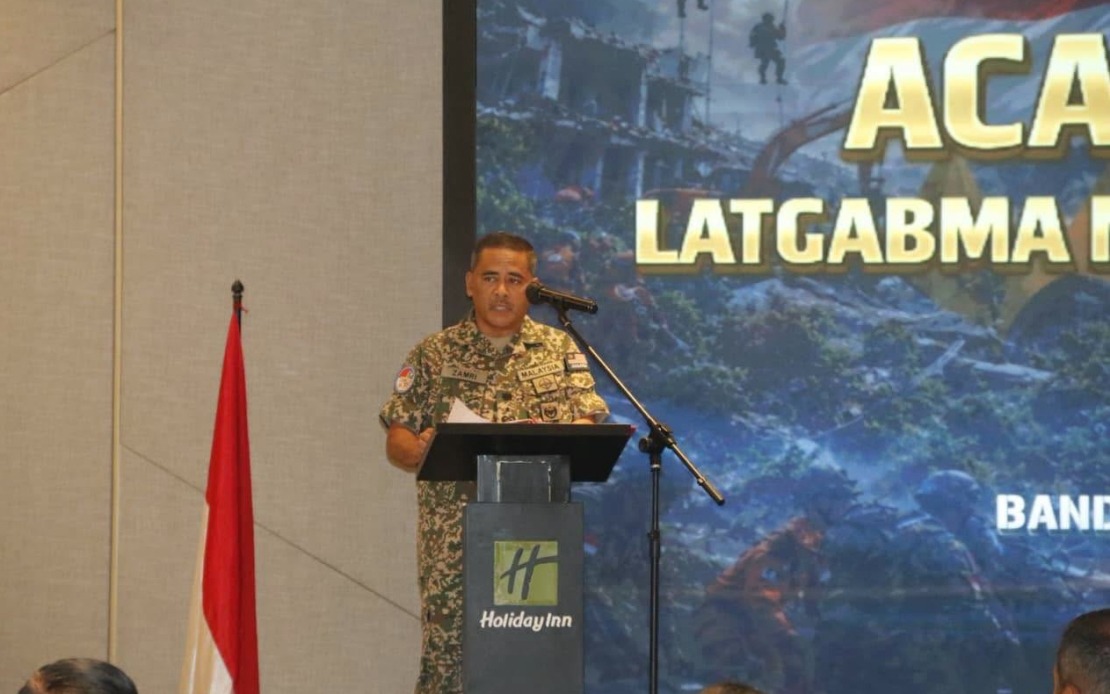
Malaysia and Indonesia have reaffirmed their defence partnership through the launch of a 13-day combined exercise in Indonesia's Lampung Province, demonstrating the two nations' commitment to military cooperation in an increasingly complex regional security landscape. The LATGABMA MALINDO DARSASA 12AB/2026 drill, which brings together 719 personnel from various branches and agencies of both countries' armed forces, represents far more than routine training for participating soldiers and officers. Rather, it underscores the deepening strategic trust between Kuala Lumpur and Jakarta at a time when both nations face overlapping security concerns that demand coordinated responses.
The exercise, hosted in Bandar Lampung and coordinated through Malaysia's Joint Forces Headquarters at Al-Sultan Abdullah Camp, reflects a deliberate strategic choice of location and focus. Lampung Province sits at the intersection of three active tectonic plate belts, making it an ideal testing ground for disaster response scenarios that mirror genuine threats facing the region. This geographical selection transforms an otherwise abstract training scenario into a realistic preparation for the natural disasters that have repeatedly struck southern Sumatra, thereby equipping personnel with practical knowledge they may need to deploy in actual emergencies affecting millions of civilians.
Brigadier General Datuk Zamri Othman, commander of the 1st Infantry Brigade and chief of the MAF Exercise Planning Group, articulated the broader strategic significance of the initiative. The exercise transcends conventional military training by serving as a platform for building institutional confidence between the two armed forces, allowing personnel at various levels to develop a shared understanding of operational procedures and joint command structures. This confidence-building dimension proves particularly valuable given the maritime complexities of the region, where coordinated action between Malaysian and Indonesian forces becomes essential when addressing transnational threats that respect no borders.
The security environment confronting Southeast Asia has evolved substantially since Malaysia and Indonesia first established their joint training framework in 1984. Beyond the traditional state-to-state military concerns that dominated Cold War thinking, both nations now grapple with an expanding array of non-traditional threats. Maritime piracy and smuggling operations exploit the vast waters of the Straits of Malacca and surrounding regions, while terrorist networks continue to recruit and operate across borders. Cybersecurity threats have emerged as a critical vulnerability for government institutions and critical infrastructure. Compounding these challenges, the Indian Ocean region's vulnerability to devastating natural disasters—earthquakes, tsunamis, and typhoons—demands rapid, coordinated humanitarian responses that cross national boundaries. These interconnected threats create a compelling case for the deepening integration of Malaysian and Indonesian defence capabilities.
The three-yearly rotation of the LATGABMA MALINDO DARSASA exercise, established through the General Border Committee and the Malaysia-Indonesia Joint Training Committee, has become a cornerstone of bilateral defence relations. The 2023 edition held in Pekan, Pahang concentrated on counter-terrorism scenarios, while this year's iteration shifts focus toward humanitarian assistance and disaster relief alongside cyber defence—a telling adjustment that reflects the evolving threat matrix. The exercise's academic component, structured as a Staff Exercise involving 10 key disaster-response scenarios, builds foundational understanding among command staff before field personnel engage in practical drills. This layered pedagogical approach—moving from classroom-based planning through tabletop exercises to full-scale field training—ensures that both individual competencies and institutional integration receive equal attention.
The exercise framework emphasizes Force Integration Training that brings together military personnel with civilian first-responder agencies, creating an integrated response architecture that mirrors real-world disaster management. Indonesia's participation includes specialized units such as the National Search and Rescue Agency (BASARNAS), Disaster Preparedness Cadets (TAGANA), and regional disaster management authorities, while Malaysia contributes the National Disaster Management Agency (NADMA) and relevant military medical units. This multi-agency approach recognizes that modern disaster response demands seamless coordination between military logistics, medical capabilities, and civilian emergency services—a complexity that cannot be adequately trained through military-only exercises.
The practical components of the training extend beyond emergency response into infrastructure restoration and public health provision. The Engineering Civil Action Programme addresses community needs in selected villages through house repairs and road construction, while the Medical Civic Action Programme delivers health screenings, optical assistance, and blood donation services at local health centres. These civic-action elements serve a dual purpose: they provide genuine service to affected communities while simultaneously training military personnel in the civilian engagement skills increasingly expected of modern armed forces operating in disaster zones. The realism of these community interactions enhances both the training value and the positive perception of military involvement in civilian domains.
Cyber defence has emerged as a novel addition to the exercise architecture, reflecting recognition that modern warfare extends into digital domains where traditional geographic boundaries dissolve. Training modules covering reconnaissance techniques, credential attacks, man-in-the-middle attacks, and information spoofing prepare participating IT specialists and cyber-defence personnel for the real threats targeting government systems across Southeast Asia. As critical infrastructure in both nations becomes increasingly digitized, the vulnerabilities exploited in cyberspace can trigger cascading failures affecting water supplies, power grids, and emergency response systems. Including cyber exercises alongside kinetic disaster-response training acknowledges this reality and ensures that military-civilian coordination extends into the digital realm.
The composition of participating forces—463 Indonesian TNI personnel, 150 Malaysian Armed Forces members, representatives from the National Disaster Management Agency, Indonesian police units, and dozens of civilian agency staff—reflects the integrated nature of contemporary security challenges. No single military service possesses all the capabilities required for effective humanitarian response or cyber defence. The Malaysian contingent, though numerically smaller than its Indonesian counterpart, brings specialized expertise and interoperability knowledge essential for the two forces to operate effectively as a unified command structure. This asymmetry in numbers, which varies depending on the host nation, actually enhances training value by forcing both sides to develop procedures for operating in mixed-composition units where mutual understanding and clear communication protocols become paramount.
For Malaysia specifically, this exercise carries particular significance given the country's extensive maritime borders and exposure to transnational maritime crime, irregular migration, and potential terrorist infiltration. The exercise provides opportunities to test coordination mechanisms with Indonesia on naval operations, maritime patrol procedures, and joint responses to incidents occurring in contested or shared waters. The humanitarian focus also reflects Malaysia's aspirations within Southeast Asia as a moderate, stability-focused power willing to lead regional cooperation on common challenges. By demonstrating commitment to disaster preparedness alongside military capability development, both nations signal to the broader region and international community that their defence cooperation serves constructive, non-threatening purposes.
The selection of Humanitarian Aid and Disaster Relief as the central theme for this edition aligns with Malaysia and Indonesia's mutual experience of devastating natural disasters and their moral obligations as relatively well-resourced regional powers to assist affected populations. Typhoon seasons, earthquake swarms, and the ever-present tsunami threat impose recurring humanitarian demands on both nations' emergency response systems. By investing in joint training infrastructure that directly enhances capacity to save lives, both Malaysia and Indonesia demonstrate that military modernization serves human protection rather than regional militarization. This framing proves particularly important in Southeast Asia's sensitive geopolitical context, where military-to-military exercises sometimes provoke concern among neighboring states or great powers.
Looking forward, the continuation and evolution of LATGABMA MALINDO DARSASA illustrates both nations' recognition that shared security challenges demand institutionalized cooperation mechanisms immune to the inevitable fluctuations in bilateral political relations. Defence cooperation, when properly structured around concrete operational requirements and mutual benefit, can survive periods of diplomatic tension and actually serve as a stabilizing force in the relationship. The exercise's triennial rotation ensures both countries remain engaged in regular confidence-building activities while distributing hosting responsibilities and training investment equitably. As Southeast Asia navigates an increasingly contested regional environment marked by great-power competition and non-traditional security threats, the Malaysia-Indonesia defence partnership exemplified by this exercise represents a model of practical, results-oriented regional cooperation that warrants sustained commitment and resource allocation.