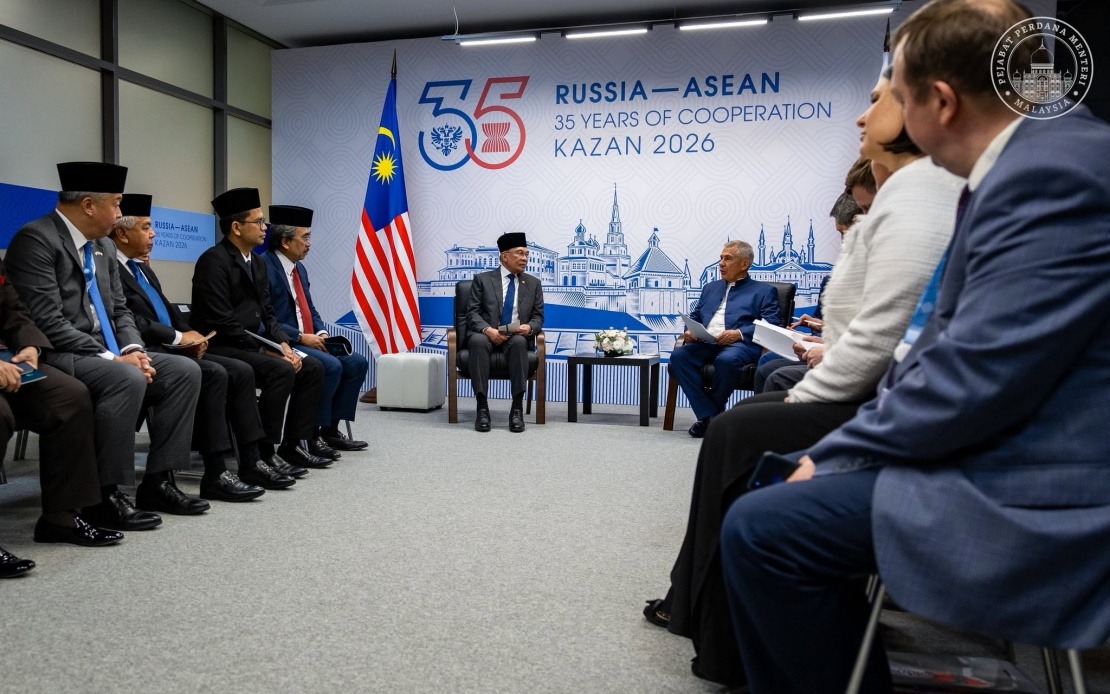
Prime Minister Datuk Seri Anwar Ibrahim has identified substantial scope for Malaysia and the Republic of Tatarstan to deepen bilateral engagement across numerous economic and social dimensions. The pronouncement emerged following a meeting with Rustam Minnikhanov, the Rais (Head) of Tatarstan, in the Russian city of Kazan. Anwar, who holds the dual portfolio of Finance Minister, emphasised that collaborative opportunities span trade, investment, education, tourism, the halal sector, technological advancement, and workforce development—reflecting a comprehensive agenda to strengthen ties between the two regions.
The energy sector emerged as a central focus in discussions between the two officials, given Tatarstan's significance as one of Russia's principal oil-producing regions. Anwar outlined particular interest in harnessing bilateral potential across the full spectrum of petroleum activities, from crude extraction through to downstream processing, refining operations, and petrochemical manufacturing. This emphasis underscores Malaysia's strategic interest in accessing Russia's hydrocarbon resources and expertise, while simultaneously offering Malaysian technological capabilities and downstream services to Russian producers. Such collaboration could prove mutually advantageous, particularly as global energy markets experience ongoing volatility and producers seek diversified partnership arrangements.
Beyond the energy domain, Anwar and Minnikhanov explored the expanding role of the Kazan Forum as a mechanism for strengthening commercial relationships between their respective business communities. The discussions extended to emerging sectors including innovation, digital economy development, and strategic investment opportunities. This forward-looking perspective reflects a recognition that 21st-century economic cooperation increasingly centres on high-value, knowledge-intensive sectors rather than commodity trading alone. For Malaysian stakeholders, such engagement offers pathways to access Russian technological capabilities and investment capital, while positioning Malaysian enterprises as partners in Russia's digital transformation initiatives.
The bilateral meeting also witnessed Anwar's recognition of Kazan's designation as the Islamic World Cultural Capital 2026 by the Islamic World Educational, Scientific and Cultural Organisation. This distinction carries particular resonance for Malaysia given the nation's position as a leading Islamic economy and cultural centre. Kazan's historical significance as a bastion of Islamic scholarship, cultural expression, and innovation presents opportunities for Malaysian institutions—universities, cultural organisations, and businesses in the halal sector—to establish partnerships and collaborative frameworks. The city's millennium-spanning history and recognised standing as a centre of Islamic heritage create natural synergies with Malaysian interests in promoting Islamic civilisation and knowledge exchange.
Anwar also commended President Vladimir Putin's initiative in establishing the Strategic Vision Group, characterising it as a vital conduit for fostering dialogue and substantive cooperation between Russia and the Islamic world. This institutional framework assumes importance for Malaysia's broader foreign policy objectives, particularly as the nation seeks to strengthen relationships with non-traditional partners and build bridges between major powers and Islamic-majority nations. The mechanism potentially enables Malaysian policymakers to influence regional geopolitical dynamics and advance shared interests in peace, stability, and development across Eurasia and beyond.
The Prime Minister's visit to Kazan represents a significant diplomatic engagement, undertaken as part of a two-day working mission to attend the ASEAN-Russia Commemorative Summit. This summit constitutes the apex platform for institutional dialogue between the ten-member ASEAN bloc and the Russian Federation, reflecting a relationship trajectory that has matured substantially since initial dialogue arrangements commenced in 1991. Russia's elevation to full ASEAN Dialogue Partner status in 1996 and subsequent designation as a Strategic Partner in 2018 underscore the deepening institutional embedding of bilateral cooperation frameworks. These hierarchical upgrades signal mutual commitment to expanding engagement across political-security dimensions, economic integration, and sociocultural exchange initiatives.
Anwar arrived in Kazan accompanied by a delegation reflecting Malaysia's multifaceted diplomatic apparatus. The contingent included Datuk Seri Johari Abdul Ghani in his capacity as Investment, Trade and Industry Minister, Akmal Nasrullah Mohd Nasir representing the Economy portfolio, alongside officials from the Prime Minister's Office and the Foreign Ministry. This composition underscores the economic and strategic significance accorded to the visit, with representation spanning trade, investment, and industrial policy domains. The delegation's breadth indicates Malaysia's intention to activate engagement across multiple governmental touchpoints and explore concrete cooperation mechanisms extending beyond ceremonial diplomatic exchanges.
Kazan itself possesses considerable strategic and historical importance within the Russian Federation's geographic and cultural landscape. Situated at the confluence of the Volga and Kazanka rivers in the European expanse of Russia, approximately 800 kilometres east of Moscow, the city sustains a population exceeding 1.3 million inhabitants. Its frequent characterisation as Russia's "third capital" following Moscow and Saint Petersburg reflects both its economic significance and cultural standing. The city's historical continuum spanning more than a thousand years, combined with its established position as a premier centre of Islamic culture and heritage within the Russian context, renders it an appropriate venue for high-level ASEAN-Russia engagement and discussions concerning Islamic cultural diplomacy and cooperation.
For Malaysian observers and policymakers, the bilateral engagement between Anwar and Minnikhanov carries implications extending beyond immediate bilateral relations. The meeting reflects Malaysia's strategic positioning within broader geopolitical realignments occurring across Eurasia, as nations recalibrate partnerships in response to shifting global power distributions and economic interdependencies. Malaysia's engagement with Russia through ASEAN frameworks, combined with parallel bilateral diplomacy, enables the nation to maintain strategic autonomy while cultivating relationships across the broader Eurasian space. This approach contrasts with zero-sum geopolitical competition and advances Malaysian interests in regional stability, economic diversification, and cultural dialogue between Islamic and non-Islamic civilisations.
The emphasis on halal industry cooperation deserves particular attention, as this sector represents a distinctive Malaysian competitive advantage within global markets. Tatarstan's Muslim-majority population and cultural orientation towards Islamic traditions create natural demand for Malaysian halal products, certification expertise, and industrial standards. Malaysian leadership in establishing halal protocols, logistics, and marketing channels positions the country as a valuable knowledge partner for Russian entrepreneurs seeking to capture burgeoning Islamic consumer markets. This dimension of cooperation reflects Malaysia's broader strategy of leveraging religious-cultural identity as a commercial and diplomatic asset within international relations frameworks.
Educational and talent development cooperation mentioned during discussions carries long-term strategic implications. Malaysian educational institutions, particularly those offering technical and vocational training, possess capacities relevant to Russian workforce development initiatives. Conversely, Russian expertise in engineering, aerospace, and advanced manufacturing offers learning opportunities for Malaysian technical education providers. Student and faculty exchange programmes, joint research initiatives, and institutional partnerships could deepen intellectual connections between Malaysian and Tatarstan scholars, fostering personal relationships and mutual understanding that transcend governmental cycles and institutional fluctuations.
The Kazan summit itself represents an important opportunity for ASEAN to collectively advance shared interests with Russia across multiple dimensions. For Malaysia specifically, the gathering enables bilateral engagement with Russian counterparts while maintaining collective ASEAN positioning on regional and international issues. This dual-track engagement approach—simultaneous bilateral relationship cultivation and multilateral coordination within ASEAN—reflects sophisticated diplomatic strategy. Malaysia's approach to Russia balances principled positions on international law and multilateral cooperation frameworks with pragmatic recognition of Russia's enduring geopolitical significance and economic potential within Eurasian markets and global energy systems.