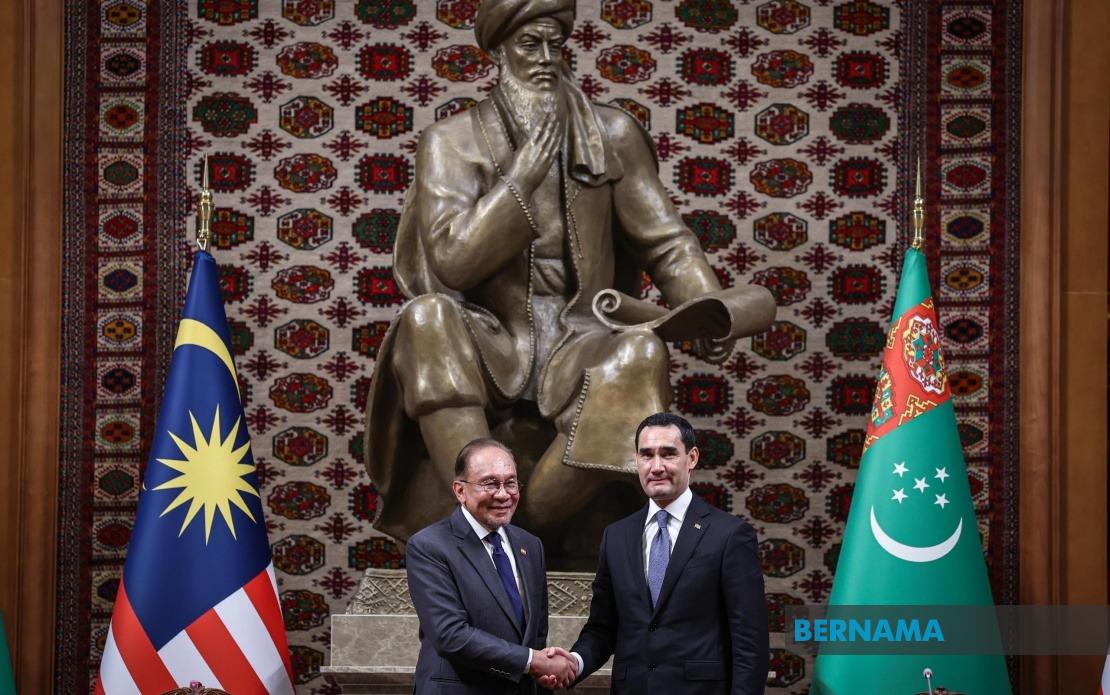
Prime Minister Datuk Seri Anwar Ibrahim and Turkmenistan President Serdar Berdimuhamedov have committed to transforming Malaysia-Turkmenistan relations into a structured, progressive partnership grounded in mutual strategic interests and long-term benefit to both populations. The declaration came following formal bilateral talks at the Presidential Palace in Ashgabat on Friday, culminating in the exchange of multiple agreements that signal the two nations' intent to move beyond symbolic diplomatic relations into concrete, measurable cooperation across diverse economic and institutional sectors.
The foundation for this expanded engagement rests on four binding documents signed during the official visit, including an Air Services Agreement that will facilitate greater connectivity between the two countries. The accord represents a particularly significant development for Malaysia's regional positioning, as improved aviation links with Central Asia could open new trade corridors and enhance tourism flows in both directions. Beyond air transport, the bilateral framework encompasses memoranda of understanding between Malaysia's Institute of Diplomacy and Foreign Relations and Turkmenistan's corresponding Institute of International Relations, signalling a commitment to sustained diplomatic dialogue at the institutional level rather than relying solely on periodic high-level visits.
Both governments emphasised that all agreed areas of cooperation will proceed according to rigorous standards of discipline, transparency and operational effectiveness. This language reflects a deliberate pivot away from aspirational agreements that languish in bureaucratic limbo. For Malaysia, which has pursued an increasingly diversified foreign policy under Anwar's administration, the Turkmenistan partnership offers strategic value beyond immediate commercial returns. Turkmenistan's position as a major energy exporter and Central Asian hub creates potential synergies with Malaysia's role as a regional financial centre and halal industry leader, positioning both nations to benefit from complementary strengths rather than competitive overlap.
The scope of bilateral dialogue encompassed an unusually broad array of sectors that underscores the comprehensive nature of the engagement. Energy cooperation emerged as a prominent theme, reflecting Turkmenistan's substantial hydrocarbon resources and Malaysia's experience in petroleum sector development and governance. However, the partnership extends far beyond extractive industries into knowledge-based domains including Islamic banking and finance, where Malaysia has established itself as a global standard-setter. This dimension holds particular relevance for Malaysian financial institutions seeking to expand into Central Asia, where Islamic finance remains underdeveloped despite growing Muslim populations across the region.
The halal industry represents another focal point with significant implications for Malaysian commerce. As a global halal certification and product leader, Malaysia stands to promote halal-compliant manufacturing and trade standards in Turkmenistan, potentially creating new markets for Malaysian halal exports whilst simultaneously positioning Malaysian companies to service the Central Asian region. Educational and scientific cooperation, formalized through an agreement between Malaysia's Academy of Sciences and Turkmenistan's corresponding institution, suggests a deeper commitment to capacity-building and knowledge transfer across multiple disciplines. Such arrangements typically precede more substantial commercial partnerships by establishing personal relationships and technical familiarity among research communities.
Tourism cooperation was explicitly identified as a priority area, though neither government elaborated on specific initiatives. For Malaysia, Turkmenistan represents an emerging source market with demographic potential, whilst Central Asia's unique cultural landscape and historical Silk Road heritage could appeal to Malaysian heritage tourists. The government's inclusion of tourism in the partnership framework suggests recognition of the sector's broader economic multiplier effects beyond direct visitor spending.
Anwar's delegation composition reflected the seriousness attached to the visit. The presence of Minister of Investment, Trade and Industry Datuk Seri Johari Abdul Ghani and Minister of Economy Akmal Nasrullah Mohd Nasir signalled that this was fundamentally a business and economic mission rather than a ceremonial engagement. Trade and investment conversations typically occur in parallel to official diplomatic meetings, and the inclusion of two senior economic ministers suggests substantive commercial discussions likely proceeded beyond public announcements. For Malaysian businesses seeking emerging market opportunities, Turkmenistan's centrality to Central Asian trade and energy networks presents strategic positioning advantages.
The visit marked Anwar's inaugural official journey to Turkmenistan since assuming office as Malaysia's 10th Prime Minister in November 2022. This timing reflects a deliberate effort by the new administration to broaden Malaysia's international engagement footprint beyond traditional Southeast Asian and Middle Eastern partners. By visiting Turkmenistan within the first eighteen months of his premiership, Anwar signalled that Central Asia represents a priority region in Malaysia's foreign policy recalibration. The two-day format provided sufficient time for substantive exchanges whilst remaining efficient by international diplomatic standards.
President Berdimuhamedov's personal invitation to Anwar underscores Turkmenistan's own interest in deepening ties with Southeast Asia's major economies. Turkmenistan, despite its energy wealth, has historically maintained a carefully neutral foreign policy stance with limited high-profile international partnerships. The elevation of bilateral engagement with Malaysia suggests Turkmenistan views Southeast Asia as an increasingly important counterbalance to traditional great power dynamics in the region. For Malaysia, this reciprocal enthusiasm creates favourable conditions for translating agreements into operational programs.
The joint statement signed during the visit, though not detailed in public announcements, typically establishes overarching principles for implementation mechanisms and timelines. Such documents usually designate specific government agencies responsible for advancing each cooperative domain and establish regular review mechanisms to ensure progress. For Malaysian stakeholders, the availability of these institutional contacts provides clarity on how to navigate Turkmenistan's bureaucracy and access partnership opportunities. Given Central Asia's historical opacity and complex regulatory environments, having formal institutional pathways substantially reduces transaction costs for Malaysian enterprises.
The partnership's emphasis on "deep trust and mutual respect," articulated by Anwar at the joint press conference, acknowledges that durable bilateral relations require social and diplomatic foundations beyond transactional calculations. This framing resonates with Islamic diplomatic tradition and may reflect Anwar's personal communication style, which frequently emphasises civilisational and ethical dimensions of statecraft. For both populations, such language suggests the governments intend to cultivate broader people-to-people understanding alongside official channels.
Looking forward, the success of this partnership will depend on implementation rigor by both governments. Many developing-country bilateral agreements languish unfulfilled due to bureaucratic inertia, competing budget priorities, or shifting political circumstances. The explicit commitment to transparent, disciplined implementation provides some assurance, though genuine progress will only become evident within 12-24 months as specific projects advance. For Malaysian investors and companies, closely monitoring government follow-through on these commitments will prove essential for timing market entry and partnership development in the Turkmenistan opportunity set.