Malaysia faces an extended period of hotter and drier weather conditions as the El Niño phenomenon prepares to influence the region's climate patterns, with Deputy Prime Minister Datuk Seri Dr Ahmad Zahid Hamidi warning that impacts could extend well into early 2027. The warning signals a shift in weather patterns that will demand immediate action from both government and residents across the nation, particularly as the Southwest Monsoon season continues its course from May through September.
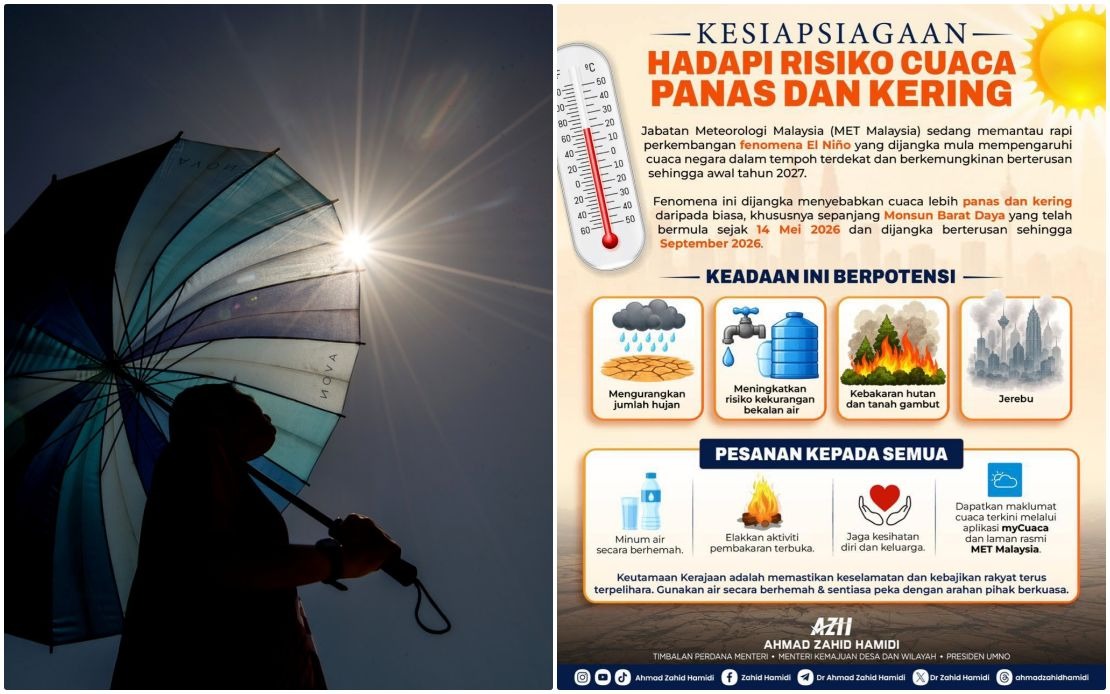
Ahmad Zahid, who serves as chairman of the Central Disaster Management Committee, outlined the principal hazards associated with this climatic shift during the Southwest Monsoon period. The anticipated weather pattern will likely suppress rainfall across multiple areas, creating heightened conditions for water scarcity and environmental stress. Beyond water shortages, the combination of extreme heat and reduced precipitation establishes ideal conditions for forest fires and peatland degradation, phenomena that have triggered transboundary haze crises affecting the broader Southeast Asian region in previous years.
The Deputy Prime Minister's public advisory emphasised personal responsibility and family preparedness as core elements of national resilience against the El Niño threat. His guidance encompassed practical measures suited to Malaysian households: prudent water consumption patterns, elimination of uncontrolled burning practices that could spark wildfires, and heightened attention to health vulnerabilities among elderly residents and young children who face greater risks during prolonged heat exposure. The messaging reinforced that individual actions, multiplied across millions of households, constitute a critical line of defence against widespread disruption.
Access to real-time weather intelligence has been positioned as central to public readiness, with Ahmad Zahid directing Malaysians to utilise the myCuaca application and resources provided by the Malaysian Meteorological Department (MetMalaysia). This emphasis on information accessibility reflects recognition that accurate forecasting enables households and businesses to make informed decisions about resource allocation and risk mitigation strategies. The digital infrastructure represents Malaysia's investment in making meteorological expertise directly available to citizens rather than filtering it through intermediaries.
MetMalaysia's director-general Dr Mohd Hisham Mohd Anip corroborated the broader assessment, noting that the phenomenon will manifest primarily through elevated temperatures and moisture deficits concentrated during the Southwest Monsoon window that commenced on May 14 and extends through September. This specific temporal framing provides a critical planning window for both government agencies and private sector entities dependent on rainfall or water resources for operations. Agricultural sectors, hydroelectric facilities, and water treatment authorities can calibrate preparations knowing the precise seasonal window of heightened risk.
The El Niño phenomenon, driven by warming ocean temperatures in the equatorial Pacific, operates as a global climate driver capable of disrupting precipitation patterns across vast distances. Southeast Asia occupies a particularly vulnerable position within this system, as the region's tropical geography and monsoon-dependent water cycles amplify the effects of reduced rainfall. Malaysia's position at the equator means exposure to multiple monsoon systems, yet El Niño's influence can suppress both the Southwest and Northeast Monsoons' traditional rainfall contributions, potentially extending drought conditions across extended periods.
Government coordination through the Central Disaster Management Committee indicates institutional recognition that El Niño impacts transcend single agencies' mandates. Water management authorities must synchronise reservoir release schedules; agricultural extension services must advise farmers on drought-resistant practices; fire departments must pre-position resources in fire-prone regions; and public health systems must prepare for heat-stress related medical emergencies. This integrated approach attempts to distribute response capacity across the entire government apparatus rather than concentrating mitigation efforts in isolated departments.
For Malaysian businesses reliant on consistent water availability—including semiconductor manufacturing, food production, and energy generation—the advisory carries significant operational implications. Water-intensive industries already operating under resource constraints in some regions may face production disruptions or elevated operational costs if drought conditions materialise as projected. Supply chain planning, contingency water sourcing, and potential production scheduling adjustments warrant board-level consideration given the multi-year timeframe of potential El Niño influence.
The extended timeline through early 2027 distinguishes this El Niño event from shorter-duration weather anomalies, requiring sustained rather than temporary institutional and household responses. Monsoon rainfall patterns represent a fundamental rhythm governing Malaysian agriculture, water provision, and ecosystem health; disruption across multiple calendar quarters tests both infrastructure resilience and social adaptability. Communities dependent on seasonal agricultural cycles face particular adjustment challenges, potentially necessitating crop selection changes or irrigation investment decisions with lasting economic consequences.
Regional implications extend beyond Malaysia's borders, as El Niño-induced drought conditions typically affect much of Southeast Asia simultaneously. Transboundary haze resulting from forest and peatland fires in neighbouring Indonesia has historically created public health emergencies across the region; coordinated preparation and early-warning systems could potentially mitigate such spillover effects. Malaysian meteorological expertise and early disaster management experience position the nation to contribute regionally to collective preparedness.
Public compliance with conservation guidance will ultimately determine whether Malaysia weathers the El Niño period with manageable disruption or faces acute resource crises. Historical experience demonstrates that water rationing becomes necessary when voluntary conservation proves insufficient, while uncontrolled burning escalates rapidly from isolated incidents into landscape-scale catastrophes. The advisory thus functions as both warning and appeal: advance voluntary action across millions of individuals can forestall coercive measures later.
Government commitment to continuous monitoring and responsive adjustment of policy measures acknowledges that climate phenomena remain partially unpredictable in their intensity and temporal distribution. Rather than presenting El Niño impacts as a fixed, predetermined outcome, official messaging frames the period ahead as manageable through collective vigilance and institutional agility. This posture balances honest communication about real hazards with reassurance that Malaysian institutions and communities possess the capacity to navigate the challenge successfully.