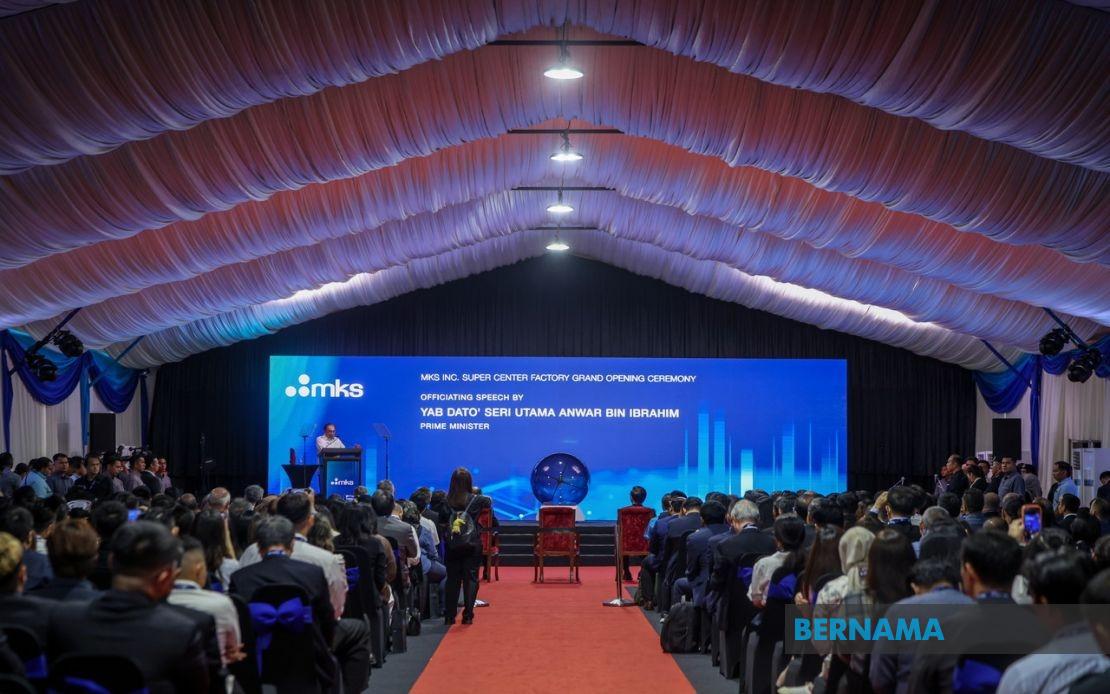
Prime Minister Datuk Seri Anwar Ibrahim has reaffirmed Malaysia's strategic positioning as a neutral player capable of building bridges across competing geopolitical spheres, a stance he argues is delivering tangible economic rewards and enhanced international credibility. Speaking at the opening of the MKS Super Centre factory in Bandar Cassia Technology Park in Batu Kawan on June 20, Anwar underscored how Malaysia's refusal to align rigidly with any single bloc while remaining engaged with multiple powers has become a source of competitive advantage in an increasingly fractured world.
The Prime Minister's remarks come against a backdrop of rising global tensions and competing spheres of influence, particularly as the United States and China vie for regional dominance and as Russia pursues its own strategic interests in Asia. By contrast, Malaysia has deliberately cultivated the image of a responsible, principled nation that can work constructively with Washington, Beijing, Moscow, New Delhi and other capitals without compromising its sovereignty or becoming trapped in zero-sum contests. This positioning reflects a consistent thread running through Malaysian foreign policy for decades, but Anwar has sharpened and articulated it more explicitly as a deliberate economic strategy.
Anwar highlighted several high-profile diplomatic engagements to illustrate the breadth of Malaysia's international reach. He referenced the presidential visit by Donald Trump last year as emblematic of strong Malaysia-United States relations, while separately pointing to ongoing cooperation with China and India as evidence of balanced engagement across Asia's major powers. The recent opening of diplomatic channels with Russia and the deepening of bilateral ties represent extensions of this multi-directional approach, demonstrating that Malaysia views engagement as a fundamental principle rather than a temporary tactical manoeuvre.
The economic dimension of this diplomatic strategy has proven particularly significant. Anwar specifically cited Petroliam Nasional Bhd's latest commercial agreement in Turkmenistan as a concrete illustration of how Malaysia's neutral, trusted status translates into business opportunities. Petronas, as Malaysia's national energy champion, benefits from the political space its government creates by maintaining credible relations across different camps. When Malaysia is seen as independent and principled rather than as a proxy for any major power, companies operating under its flag gain access to markets and partnerships that might otherwise be constrained by geopolitical suspicion.
The Turkmenistan deal is particularly instructive for understanding the economic logic underlying Malaysia's diplomatic stance. Turkmenistan, a Central Asian nation with significant hydrocarbon reserves, has historically navigated its own careful path between Russian, Chinese and Western interests. A Malaysian energy company with a government that maintains genuine independence is a more palatable partner for such nations than one perceived as beholden to a superpower. This principle extends across sectors, from infrastructure and manufacturing to financial services and technology partnerships.
Anwar's framing of Malaysia's approach as one emphasising "centrality" is revealing. The term suggests that Malaysia sees itself not as a marginal player forced into neutrality by weakness, but as a strategically central nation whose very position at the crossroads of global commerce and geopolitics gives it leverage and influence. This reframing is important for domestic morale and international perception, transforming what might historically have been viewed as non-alignment born of vulnerability into active positioning born of strategic calculation.
The Prime Minister also made clear that Malaysia's neutrality is not passive silence or indifference. Rather, Anwar stated that Malaysia remains willing to express principled positions on contentious international issues even while maintaining broad engagement. This distinction is crucial: Malaysia is not suggesting that it avoids taking stances on matters of principle, but rather that it does so from a position of earned credibility and independence rather than from alignment with any particular bloc. This allows Malaysia to advocate for its interests and values without appearing to be a mouthpiece for external powers.
The opening of the MKS Super Centre factory provided an apt venue for these remarks, with Penang Chief Minister Chow Kon Yeow and Deputy Minister of Investment, Trade and Industry Sim Tze Tzin in attendance. The event underscored how investment and manufacturing activity are themselves dimensions of Malaysia's broader international positioning. Foreign and domestic investors are more likely to commit capital to a nation perceived as stable, independent and positioned to maintain good relations with multiple trading partners and suppliers. A country trapped in geopolitical conflict or forced into bloc membership faces sanctions, investment restrictions and supply chain fragmentation.
For Malaysian readers, Anwar's emphasis on neutrality and engagement carries several implications. First, it suggests continued efforts to attract foreign direct investment from diverse sources without ideological screening. Second, it implies that Malaysia will continue seeking trade and partnership opportunities across Asia, the Middle East, Europe and beyond without the constraints that might bind more explicitly aligned nations. Third, it reinforces the government's commitment to the non-aligned principles that have underpinned Malaysian foreign policy since independence, adapted for contemporary circumstances.
Regionally, Malaysia's approach also has implications for ASEAN cohesion and Southeast Asia's broader position. As the most geopolitically fractured region globally, with members having varying alignments and strategic partnerships, Southeast Asia benefits when one of its major economies and influential voices explicitly champions the principle of balanced engagement. Malaysia's example provides diplomatic cover and normative support for other regional nations seeking to maintain their own space for manoeuvre in an age of great power competition.
The economic opportunities emerging from this diplomatic stance are not automatically guaranteed; they require active cultivation and genuine commitment to the principles articulated. Petronas and other Malaysian enterprises must continue demonstrating professional standards, reliability and ethical conduct internationally. Government institutions must maintain credible institutions and rule of law. The diplomatic advantage Malaysia enjoys is real but fragile, dependent on consistent demonstration that the nation's stated principles are genuine rather than expedient.
Looking forward, Anwar's articulation of neutrality as an active economic strategy rather than a default position suggests the government views Malaysia's geopolitical positioning as a competitive asset to be weaponised for national development. This represents a mature approach to foreign policy in which Malaysia neither hides nor apologises for its commitment to independence, but instead markets it explicitly to investors, partners and international audiences as a source of stability and opportunity in an unpredictable world.