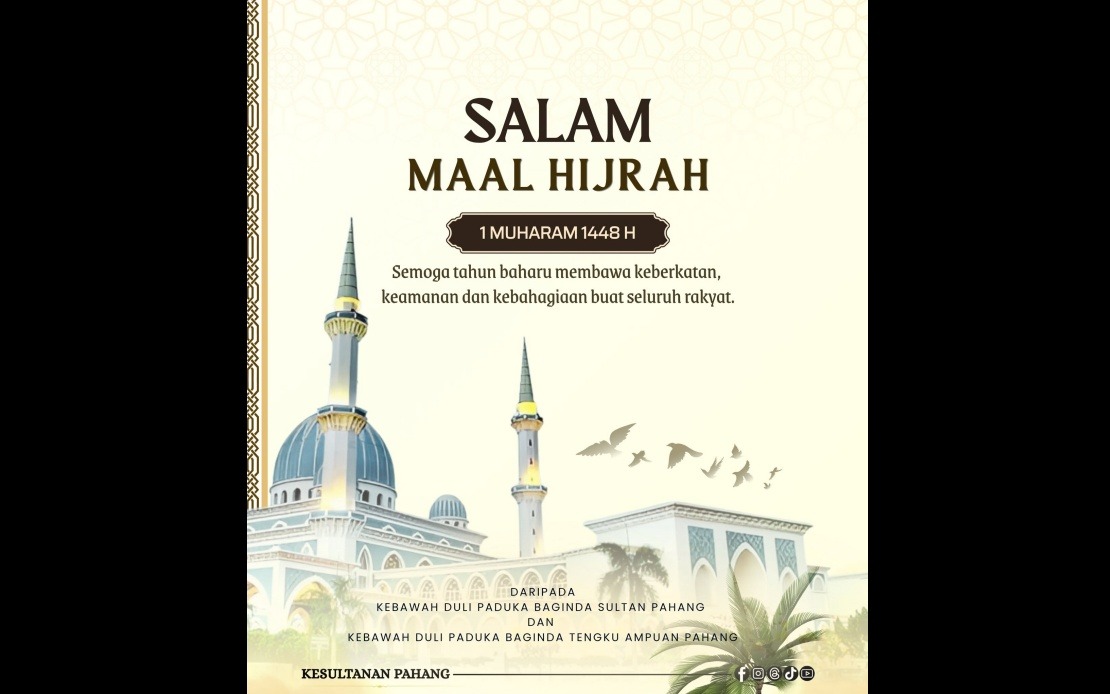
The Sultan of Pahang, Al-Sultan Abdullah Ri'ayatuddin Al-Mustafa Billah Shah, and the Tengku Ampuan of Pahang, Tunku Azizah Aminah Maimunah Iskandariah, have marked the arrival of Maal Hijrah 1448H by extending warm wishes to the Muslim community across the state. The royal message, shared through the official Kesultanan Pahang social media channels, represents a long-standing tradition of state leadership acknowledging this significant milestone in the Islamic calendar, which commemorates the Prophet Muhammad's migration to Medina.
The occasion carries particular resonance across Malaysia's sultanates, where Islamic observances intertwine with constitutional monarchy. For Pahang residents, the royal address served as both a spiritual affirmation and a reaffirmation of the sultanate's commitment to Muslim affairs in the state. The timing of such proclamations reflects the deep integration of Islamic practice within the governance structures of Malaysia's nine kingdoms, where sultans hold formal responsibility as protectors of Islam within their respective territories.
In their message, Their Royal Highnesses articulated the hope that the new Islamic year would usher in broader blessings, tranquillity, and contentment for all inhabitants of Pahang, irrespective of faith. This inclusive framing has become characteristic of official state communications during major religious observances, emphasising harmony and collective well-being. The approach acknowledges Pahang's diverse demographic composition while centring the spiritual significance of the occasion for the Muslim majority.
Paralleling the royal message, Pahang's Menteri Besar Datuk Seri Wan Rosdy Wan Ismail expanded on the theological and practical implications of Maal Hijrah observance. In his own statement, the chief minister positioned the Islamic new year as a pivotal moment for personal and communal reflection, urging Muslims to leverage the symbolic reset as a foundation for deepening religious conviction. His remarks underscored a common interpretation within Malaysian Islamic discourse: that Hijrah represents not merely a historical event but an ongoing spiritual principle of transformation and self-improvement.
The Menteri Besar's emphasis on renewing personal resolutions and intensifying charitable activities reflects established Islamic tradition while connecting it to contemporary governance priorities. By linking spiritual renewal to increased acts of benevolence, the message subtly reinforces state-level messaging about community cohesion and mutual support—themes particularly relevant in post-pandemic Malaysia, where social fabric strengthening remains a policy focus. The explicit mention of seeking divine blessings through increased charity also aligns with Islamic teachings on zakat and sadaqah, foundational pillars of Muslim practice.
Wan Rosdy's invocation of the Prophet Muhammad's Hijrah as a model for positive change introduced an aspirational dimension to the observance. Rather than treating Maal Hijrah as a purely commemorative occasion, he characterised it as a template for contemporary action: the migration narrative became a metaphor for citizens' own journeys toward moral improvement, social stability, and enhanced governance. This reframing transforms a historical religious event into a framework for addressing present-day developmental challenges, a rhetorical strategy commonly employed by Southeast Asian Muslim-majority governments seeking to align Islamic values with modernisation objectives.
The statement's emphasis on strengthening unity carries particular weight in the Malaysian context, where communal harmony remains a foundational principle of national cohesion. Pahang, as one of Malaysia's larger states with significant rural and urban populations, frequently experiences the delicate balance of managing diverse community interests. Official messaging around Islamic observances often serves as a vehicle for reinforcing national and state-level unity narratives, reminding citizens of shared values transcending ethnic and religious lines.
The invocation of integrity as a core value within the Menteri Besar's remarks reflects broader governance discourse in Malaysia, where public sector reforms increasingly emphasise ethical conduct and transparency. By embedding this principle within religious observance messaging, state leadership seeks to anchor administrative integrity in faith-based foundations, potentially strengthening public buy-in for accountability mechanisms and good governance initiatives.
The expressed commitment to advancing Pahang's development and enhancing citizen welfare through the lens of Hijrah observance demonstrates how Malaysia's political establishment routinely integrates religious commemoration with developmental aspiration. This approach suggests that progress toward state objectives—economic diversification, improved service delivery, infrastructure advancement—is understood not as secular modern enterprise but as an extension of Islamic principles and divine mandate. For Pahang specifically, such messaging carries importance given ongoing efforts to position the state as a model of balanced growth and sustainable development within the broader Malaysian federation.
The timing of these greetings, released during the early phase of the Islamic year, establishes a foundation for state-level messaging throughout the coming months. Religious observances in Malaysia's sultanates typically generate cascading communications across governmental departments, civil service units, and statutory bodies, all reinforcing similar themes of spiritual recommitment and collective advancement. This coordinated approach creates a unified cultural moment where individual, family, and state-level reflection converge around shared Islamic identity.
As Malaysia continues navigating the complexities of plural governance, religiously-inflected messages from state authorities like those from Pahang's royal household and executive leadership serve multiple functions simultaneously: spiritual affirmation for Muslim constituents, reaffirmation of institutional commitment to Islam, broader community-building signalling, and implicit alignment of religious values with developmental ambitions. The Maal Hijrah observance, therefore, transcends its commemorative purpose to become a vehicle for state articulation of values, priorities, and collective identity.