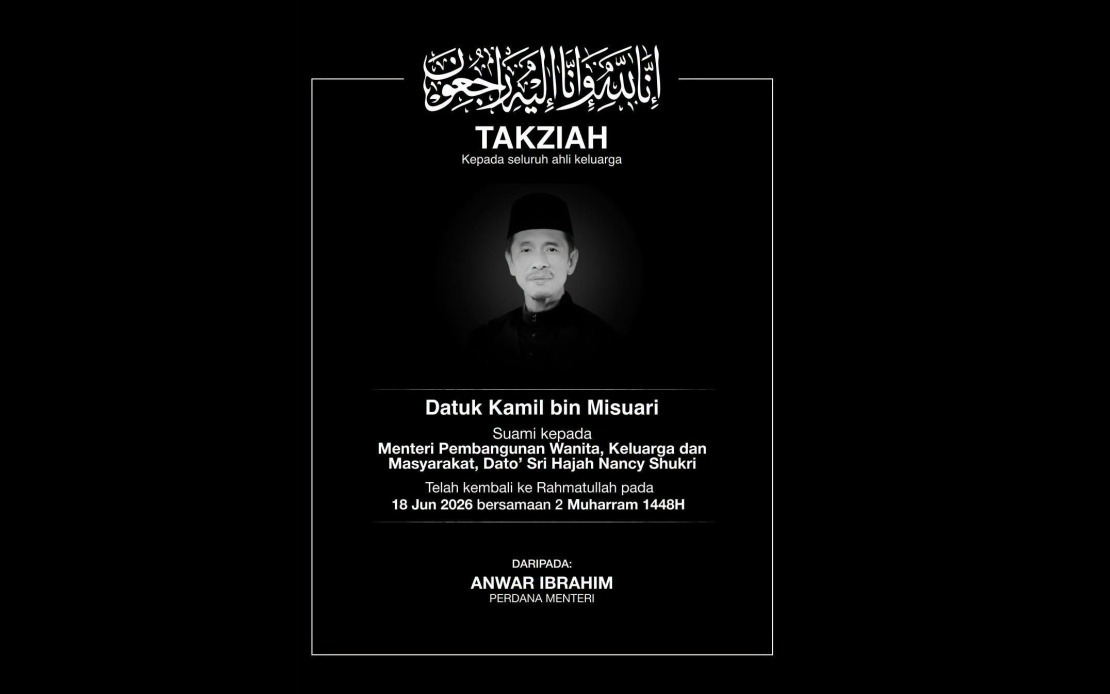
Prime Minister Datuk Seri Anwar Ibrahim and his wife Datuk Seri Dr Wan Azizah Wan Ismail have conveyed their sympathies to Women, Family and Community Development Minister Datuk Seri Nancy Shukri following the passing of her husband, Datuk Kamil Misuari, who died at a Kuala Lumpur hospital on the evening of June 18.
The Prime Minister shared his condolences through a Facebook post, expressing prayers that Nancy and her family would find the resilience needed to navigate this period of loss. Anwar's message reflected the tradition of offering spiritual support during times of bereavement, emphasizing the importance of family unity during difficult circumstances.
In his public statement, Anwar invoked religious sentiments befitting Malaysia's multicultural context, praying that the deceased's soul would be blessed and forgiven of all transgressions. The Prime Minister further expressed hope that Kamil's good deeds would be remembered and accepted, and that he would be granted an honoured place in the hereafter—words that carry particular resonance within Malaysia's Muslim-majority society.
The passing of Kamil, who was 65 years old, marks the end of a marriage that spanned nearly four decades. Nancy and Kamil were united in matrimony in 1985 and together raised three children, establishing a family life that extended across multiple decades of Malaysia's political and social landscape. The couple's long-standing union represents a significant chapter in the life of a prominent government minister who has held substantial responsibility in family and community affairs.
Following the announcement of his death by the Minister's office, arrangements were made for Kamil's remains to be transported to Sarawak the following day. The decision to return him to Kuching reflects the family's ties to the East Malaysian state, where he would be laid to rest at the Samariang Muslim Cemetery—a final resting place that would allow extended family and community members to pay their respects according to local customs and traditions.
Nancy Shukri, who holds the portfolio of Women, Family and Community Development, occupies one of Malaysia's significant ministerial positions responsible for advancing policies and programmes affecting millions of families nationwide. Her role places her at the centre of initiatives designed to strengthen family structures, support vulnerable populations, and promote community development across diverse Malaysian communities. The timing of her personal loss comes amid her continued responsibilities in the cabinet.
The expression of condolences from the highest level of government reflects Malaysia's cultural emphasis on acknowledging loss and demonstrating solidarity with bereaved colleagues and their families. Such gestures, particularly from the Prime Minister and his spouse, underscore the importance placed on personal relationships within Malaysia's political establishment and the shared values that bind leaders across different portfolios.
The passing of government officials' family members often prompts reflection on the balance between public duty and personal family obligations. Nancy's continued service in her ministerial role while managing this significant personal loss speaks to the demands placed upon Malaysia's political leadership, where public responsibilities frequently intersect with private challenges.
The broader significance of this event extends beyond the immediate family circle. It serves as a reminder of the transient nature of life and the universal experience of grief that transcends professional status and public position. The public acknowledgement of Nancy's loss by the Prime Minister's office also demonstrates the institutional culture of the Malaysian government, where recognition of personal tragedy among ministers and their families forms part of the fabric of the civil service.
As Malaysia continues to evolve its approach to family welfare and community support, the work undertaken by Nancy Shukri's ministry remains critical to addressing the diverse needs of Malaysian families. Her experience with personal loss may further inform her understanding of the challenges facing families navigating unexpected transitions and the importance of compassionate policy-making.
The ceremonial and spiritual aspects of Kamil's funeral arrangements, with transport to Sarawak and interment at a dedicated Muslim cemetery, reflect Malaysia's multicultural approach to honouring the deceased according to their faith traditions. Such practices reinforce the country's commitment to allowing different communities to observe their customs while maintaining national unity and mutual respect across religious and cultural boundaries.