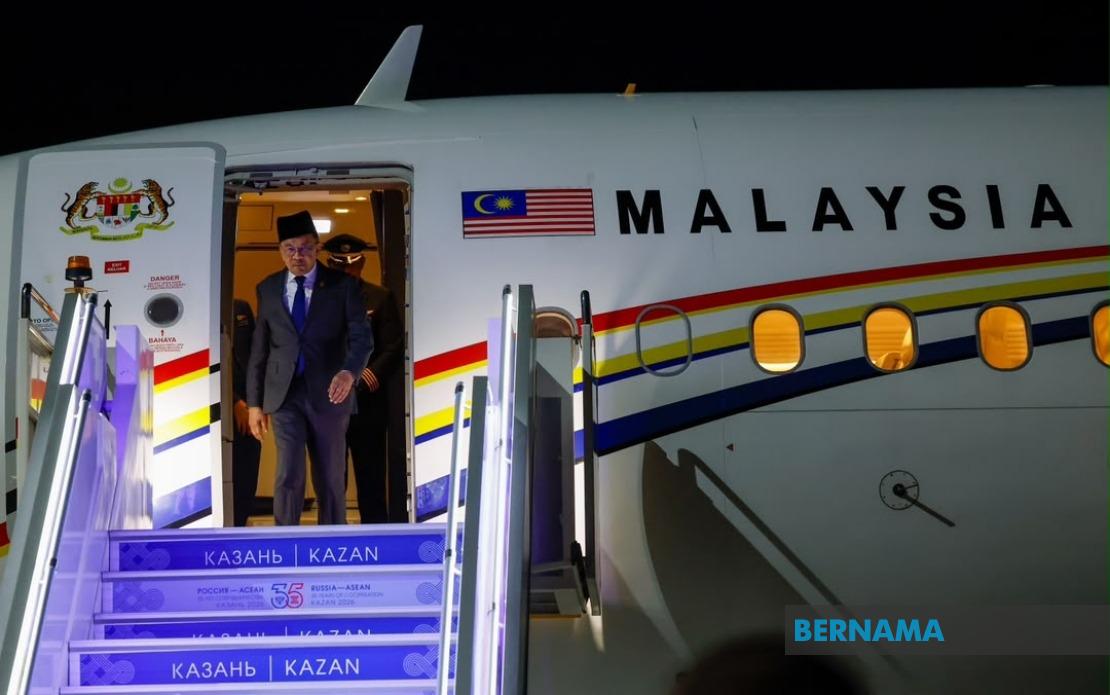
Prime Minister Datuk Seri Anwar Ibrahim touched down in Kazan on Tuesday evening to participate in a significant diplomatic gathering that underscores Malaysia's commitment to balancing its foreign relations amid geopolitical complexity. The aircraft carrying the premier landed at Kazan International Airport at 10.20 pm local time, marking the beginning of a two-day engagement that will culminate in the ASEAN-Russia Commemorative Summit on June 17-18. This visit represents a carefully calibrated step by the Malaysian leadership to maintain constructive ties with Russia while managing the sensitivities inherent in ASEAN's broader diplomatic portfolio across divergent international alignments.
The delegation accompanying Anwar reflects the multifaceted nature of the engagement, with Minister of Investment, Trade and Industry Datuk Seri Johari Abdul Ghani and Minister of Economy Akmal Nasrullah Mohd Nasir joining senior officials from the Prime Minister's Office and the Foreign Ministry. Their presence signals that economic and commercial dimensions will feature prominently in bilateral discussions. Upon arrival, Malaysia's Ambassador to Russia Datuk Cheong Loon Lai coordinated the reception, whilst the Russian side was represented by the Minister of Digital Development of Tatarstan Ilya Nachvin, Kazan Mayor Ilsur Metshin, and protocol officials. This choreography of welcoming parties underscores the formal significance both nations place on the gathering.
The Kazan summit takes on heightened importance as it coincides with the 35th anniversary of ASEAN-Russia diplomatic relations, which were formally established in Kuala Lumpur in 1991. Three and a half decades of engagement provide a substantial foundation for regional cooperation, though the relationship has evolved considerably given shifts in global power dynamics and ASEAN's own maturation as a geopolitical entity. The retrospective element built into the summit's design allows both sides to assess what has been accomplished whilst establishing a framework for future collaboration that addresses contemporary challenges absent during the relationship's inception.
The substantive agenda encompasses an expansive range of sectors reflective of modern state-to-state cooperation frameworks. Trade and investment cooperation forms a cornerstone, as energy security, food security, and digital economy development emerge as critical priorities for ASEAN nations navigating supply chain vulnerabilities and technological disruption. Science and technology collaboration, alongside cultural and educational exchanges, seeks to deepen institutional linkages and foster human capital development. Tourism and people-to-people exchanges represent softer dimensions designed to build understanding and reduce friction across societies, an element particularly valuable given diverse worldviews within ASEAN and between the bloc and Russia.
Four outcome documents are anticipated from the summit, signalling the formal institutionalisation of commitments. The Kazan Declaration on the 35th Anniversary of ASEAN-Russia Relations will provide political cover and ceremonial acknowledgment of the relationship's longevity. Separate joint statements on energy cooperation and cultural cooperation address sectors of mutual interest, whilst the Comprehensive Plan of Action to Implement the ASEAN-Russia Strategic Partnership 2026-2030 extends the partnership framework across a critical five-year horizon. These documents collectively aim to inject operational substance into high-level political declarations and provide measurable benchmarks against which implementation can be assessed.
For Malaysia specifically, this engagement reinforces broader positioning objectives within ASEAN and the international system. Malaysian Ministry of Foreign Affairs statements emphasise the visit as reflecting the country's dedication to strengthening ASEAN's external relations and promoting ASEAN Centrality, a diplomatic principle that has gained importance as ASEAN seeks to maintain agency amid great power competition. Practical cooperation with dialogue partners like Russia is framed as instrumental to building resilience in an increasingly fragmented global environment characterised by competing blocs and ideological divides. This language carefully avoids alignment whilst stressing pragmatic engagement.
During his Kazan sojourn, Anwar is scheduled to meet Russian President Vladimir Putin and the Rais of the Republic of Tatarstan, conversations that will likely address bilateral dimensions beyond the multilateral summit agenda. The prime minister intends to prioritise dialogue and peace advocacy, economic resilience strengthening, advancement of energy and food security initiatives, and deepening of people-to-people connections. These thematic areas reflect Malaysian concerns about regional stability, economic sustainability, and social cohesion, priorities that resonate across Southeast Asia where countries face common challenges in managing development whilst maintaining internal harmony and external peace.
This represents Anwar's third visit to Russia since assuming office in November 2022, indicating a consistent pattern of engagement with Moscow despite Malaysia's traditional Western security alignments. His inaugural Russian engagement occurred in September 2024 when he attended the Eastern Economic Forum in Vladivostok, a venue for showcasing Far Eastern development initiatives. Subsequently, Anwar conducted an official visit to Moscow in May 2025, during which he engaged Putin on an impressive spectrum of cooperation areas spanning trade, investment, agriculture, education, aerospace, and energy. This progression from economic forum participation to bilateral diplomacy to multilateral summit engagement demonstrates a structured approach to relationship development.
The Kazan summit's timing intersects with broader regional and global developments that lend particular salience to ASEAN-Russia engagement. Energy cooperation assumes heightened urgency given global fuel market volatility and ASEAN's significant energy consumption relative to its production capacity. Food security discussions respond to supply chain fragmentation demonstrated during and after the pandemic, with agricultural cooperation potentially addressing regional food price instability. Digital economy cooperation recognises that technological advancement and digital infrastructure development are no longer peripheral but central to economic competitiveness and geopolitical influence.
From a Malaysian perspective, this visit serves multiple purposes simultaneously. It maintains constructive relations with a significant power whilst demonstrating ASEAN's diplomatic independence and commitment to genuine strategic autonomy. It creates space for addressing bilateral economic interests, particularly in energy and trade corridors, without appearing to pivot away from traditional Western partnerships. For ASEAN collectively, the summit represents an opportunity to deepen cooperation with Russia in practical sectors where mutual benefit is demonstrable, thereby countering narratives of inevitable alignment with Western-led structures or complete isolation from major powers.
The visit also reflects Malaysia's careful navigation of a multipolar world where isolation from any significant player carries economic and strategic costs. Rather than treating engagement with Russia as binary choice requiring philosophical commitment, Malaysian diplomacy treats it as functional cooperation in mutually beneficial areas. This pragmatism, increasingly characteristic of ASEAN member state approaches, contrasts with earlier Cold War dynamics and suggests a matured regional stance capable of managing relationships across geopolitical divides.