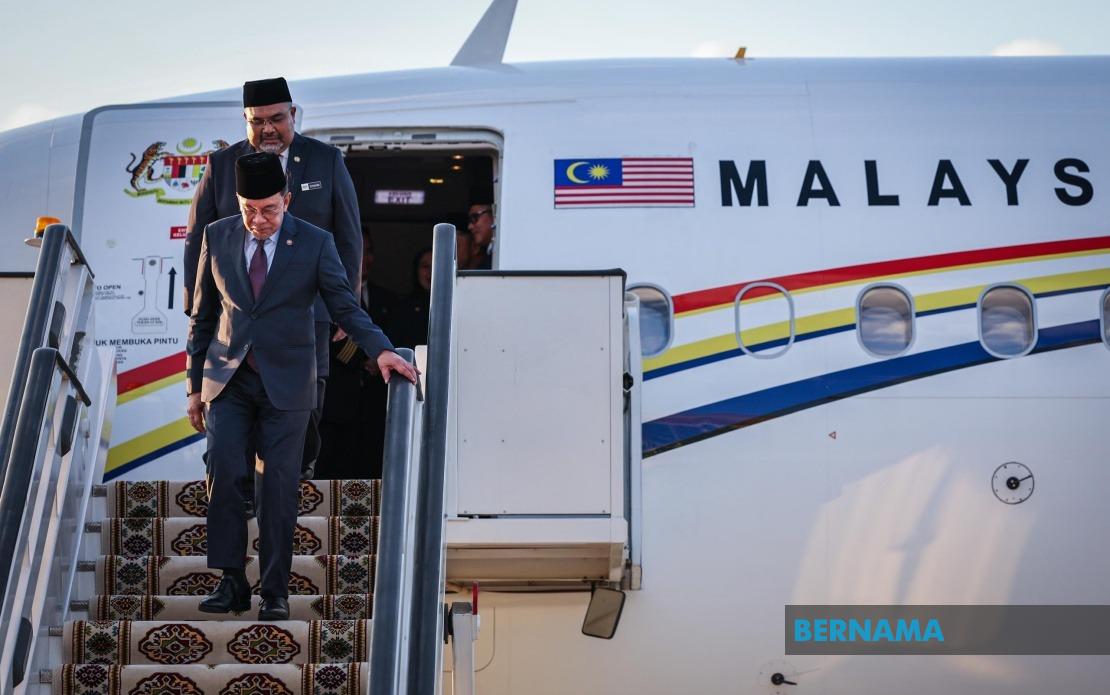
Prime Minister Datuk Seri Anwar Ibrahim touched down in Ashgabat on June 18 to begin a two-day official visit to Turkmenistan, marking a significant step in Malaysia's intensifying diplomatic outreach across Central Asia. The arrival came after Anwar completed a working visit to Kazan in the Republic of Tatarstan, extending a broader regional tour that underscores Kuala Lumpur's strategic interest in strengthening ties beyond traditional Southeast Asian partnerships. The prime minister's delegation touched down at Ashgabat International Airport at 8 pm local time, accompanied by a substantial contingent including Minister of Investment, Trade and Industry Datuk Seri Johari Abdul Ghani and Minister of Economy Akmal Nasrullah Mohd Nasir, signalling the economic significance of the mission.
The visit represents a reciprocal gesture following Turkmenistan President Serdar Berdimuhamedov's official visit to Malaysia in December 2024, reflecting a pattern of high-level engagement between the two nations. For Malaysia, this journey holds particular symbolic importance as Anwar's first official visit to Turkmenistan and the fifth such mission by a Malaysian prime minister to the oil-rich Central Asian state. Upon arrival, the prime minister was formally received by Malaysia's Ambassador to Turkmenistan Mohd Suhaimi Ahmad Tajuddin, while Turkmenistan's side was represented by Deputy Chairman of the Cabinet of Ministers for Oil and Gas Guvanch Agajanov, underscoring the petroleum sector's centrality to bilateral relations.
The economic dimensions of Malaysia-Turkmenistan engagement reveal a deepening commercial relationship that extends well beyond ceremonial state visits. In 2025, Turkmenistan ranked as Malaysia's fourth-largest trading partner among Central Asian nations, demonstrating Kuala Lumpur's expanding commercial footprint in a region historically less visible in Malaysian foreign policy discourse. Bilateral trade reached RM75.80 million, with Malaysian exports accounting for RM75.50 million of that figure, representing a robust nine per cent year-on-year growth that underscores the commercial momentum driving the partnership forward.
Yet the true measure of Malaysia's commitment to Turkmenistan extends far beyond merchandise trade figures. Petronas, Malaysia's national oil company, has become one of the most significant foreign investors in Turkmenistan, with cumulative investments totalling RM52.73 billion since establishing operations there in 1996. This massive capital presence reflects Petronas's critical role in developing Turkmenistan's energy resources and positions the Malaysian energy giant as a cornerstone of the bilateral economic relationship. The scale of Petronas's engagement demonstrates how energy diplomacy has become intertwined with political relations, making visits such as Anwar's part of a broader framework of institutional and commercial interconnection.
Turkmenistan itself occupies an unusual position in Central Asian geopolitics, being the world's fourth-largest proven natural gas reserves holder while maintaining a policy of neutrality in regional affairs. For Malaysia, engagement with Turkmenistan offers multiple strategic advantages: access to energy resources critical for long-term development, opportunities for Malaysian companies to participate in extraction and downstream operations, and a foothold in a region of growing geopolitical importance as competition among great powers intensifies. The presence of Anwar and his economic ministers signals Malaysia's determination to leverage these advantages while strengthening political foundations that protect existing investments.
The structured itinerary for June 19 reveals the careful choreography that accompanies presidential-level visits in Central Asia. President Berdimuhamedov will host Anwar at the Presidential Palace for a formal welcoming ceremony, followed by bilateral negotiations at the government level. The joint statement that both leaders are scheduled to sign, coupled with the exchange of agreements and memoranda of understanding, will likely address expanded cooperation in energy, trade, investment facilitation, and possibly defence or security matters. Such documents typically serve as blueprints for intensified institutional engagement over the following year.
Anwar's participation in a Malaysia-Turkmenistan Forum jointly hosted with President Berdimuhamedov at the Chamber of Commerce and Industry of Turkmenistan represents an effort to engage not merely governments but broader business communities on both sides. Such forums create platforms for Malaysian companies seeking expansion opportunities in Central Asia, while also inviting Turkmen enterprises to explore Malaysian markets and investment possibilities. For Malaysian entrepreneurs, Turkmenistan presents frontier opportunities in energy, infrastructure, and industrial sectors where Malaysian expertise and capital can add value.
The visit also includes Anwar attending Friday prayers at the Turkmenbashi Ruhy Mosque, a gesture that reflects Malaysia's identity as a Muslim-majority nation and acknowledges the shared Islamic heritage that partially underpins diplomatic relations in the region. This blend of commercial pragmatism with cultural and religious resonance characterises contemporary Malaysian diplomacy in Central Asia—recognising that durable partnerships rest on multiple foundations rather than transactional exchanges alone.
From a broader Southeast Asian perspective, Anwar's Central Asian engagement signals Malaysia's refusal to allow its foreign policy to be circumscribed by regional geography alone. At a time when great power competition reshapes global alignments, Malaysia's cultivation of relationships with resource-rich nations in Central Asia, combined with its traditional anchoring in ASEAN, reflects a sophisticated balancing act. Turkmenistan's strategic location along historical Silk Road trade corridors, combined with its hydrocarbon wealth, makes it valuable to a Malaysia increasingly interested in diversifying its international partnerships and ensuring energy security for its development aspirations.