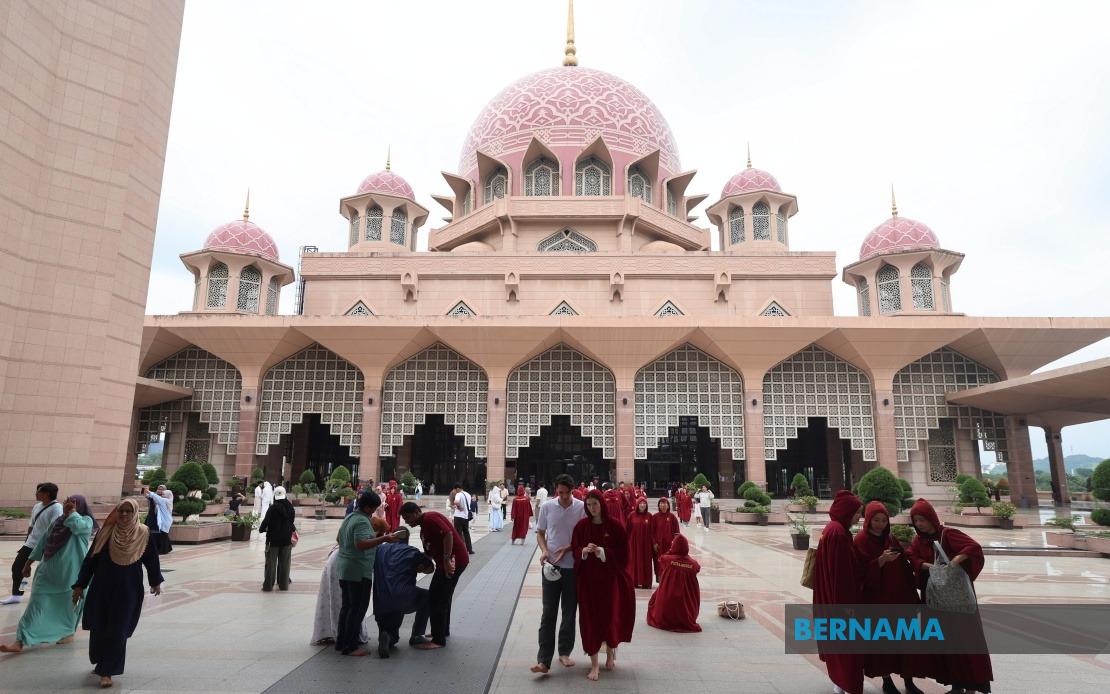
The Putra Mosque in Putrajaya is set to become the focal point of Malaysia's National Maal Hijrah observance this week, bringing together an estimated 5,000 attendees from within the country and beyond for a significant religious and cultural commemoration. The event marks the Islamic New Year celebration, an occasion of profound spiritual significance that resonates across Muslim communities worldwide. Sultan of Perak Sultan Nazrin Shah will preside over the ceremony, lending the occasion formal state recognition and ceremonial gravitas befitting its national importance.
The gathering represents a convergence of Malaysia's political and administrative leadership alongside representatives from the international community, underscoring the nation's commitment to promoting Islamic values on a regional and global stage. Deputy Prime Ministers Datuk Seri Ahmad Zahid Hamidi and Datuk Seri Fadillah Yusof are confirmed participants, alongside numerous Cabinet ministers and senior officials from various government departments and agencies. This high-level attendance demonstrates the Malaysian government's investment in religious observance as a cornerstone of national identity and cohesion.
Central to the ceremony's significance is the Sultan's keynote address, through which royal perspectives on Islamic teachings and their contemporary application will be shared with the assembled audience. The address traditionally sets the intellectual and spiritual tone for the occasion, guiding reflection on principles drawn from Islamic history and theology. Following this pivotal moment, attention will turn to the presentation of the National and International Tokoh Maal Hijrah Awards, honours that recognise exceptional individuals whose contributions to Islam and Islamic scholarship have achieved recognition beyond conventional measures.
These prestigious awards function as a mechanism for identifying and celebrating role models whose lives embody the ideals the Maal Hijrah celebration seeks to promote. Recipients are selected based on rigorous criteria encompassing deep knowledge within their professional and spiritual domains, demonstrated moral integrity, and measurable contributions to the expansion and strengthening of Islam at both domestic and international levels. By honouring such individuals publicly, the Malaysian state reinforces its message that Islamic advancement depends upon personal excellence and commitment to shared values.
The Department of Islamic Development Malaysia, known as JAKIM, has structured this year's commemoration around a central thematic concept designed to reconnect contemporary Muslims with the historical and spiritual essence of Prophet Muhammad's Hijrah. This pivotal migration from Mecca to Medina represents far more than a geographical displacement; it symbolises a transformative moment that established the institutional and spiritual foundations upon which Islamic civilisation subsequently developed. By encouraging today's Muslims to internalise this historical narrative, the observance aims to inspire constructive personal and communal change grounded in religious principle.
Innovating upon established formats, organisers have introduced the Tausiyyah @ Maal Hijrah programme, which took place at the Putra Mosque on the day preceding the main celebration. This reflective initiative invites participants to engage in deep contemplation of Quranic passages, moving beyond surface-level recitation to explore the layered meanings, ethical guidance, and practical wisdom embedded within Islamic scripture. Distinguished reciters of the Quran, known as qari, provided vocal renditions of selected verses, while scholars and educators facilitated discussion helping attendees to understand how Quranic principles translate into daily life and decision-making.
This pedagogical approach reflects contemporary Islamic education methodology, which emphasises experiential learning and personal application rather than rote memorisation. By positioning Hijrah as a transformative catalyst for positive change, the programme reframes the Islamic calendar milestone not merely as a historical anniversary but as an opportunity for spiritual renewal and practical recommitment to Islamic ethics. Such programming extends the celebration beyond ceremonial observation into substantive engagement with religious meaning.
Extending the commemorative activities beyond the main event, organisers have scheduled the National and International Tokoh Maal Hijrah Lecture 1448H/2026 for the following day at the Putrajaya Islamic Complex Auditorium, commencing at 9 am. This subsequent gathering creates space for award recipients to function as educators and inspirational figures, sharing their accumulated knowledge, professional experiences, and spiritual insights with broader audiences. The format acknowledges that recognised scholars and practitioners serve as crucial bridges between theoretical Islamic knowledge and its practical manifestation in contemporary society.
For Malaysian observers and the international Muslim community monitoring developments in Southeast Asia, this celebration demonstrates Malaysia's sustained institutional commitment to maintaining Islamic observance within the framework of a pluralistic nation-state. The event's prominence, scale, and official status indicate that religious commemoration remains a priority within Malaysia's governance structures and public calendar. The gathering also provides an occasion for examining how Islamic teachings are being interpreted and promoted by Malaysia's intellectual and political leadership during a period of evolving regional dynamics and global religious discourse.