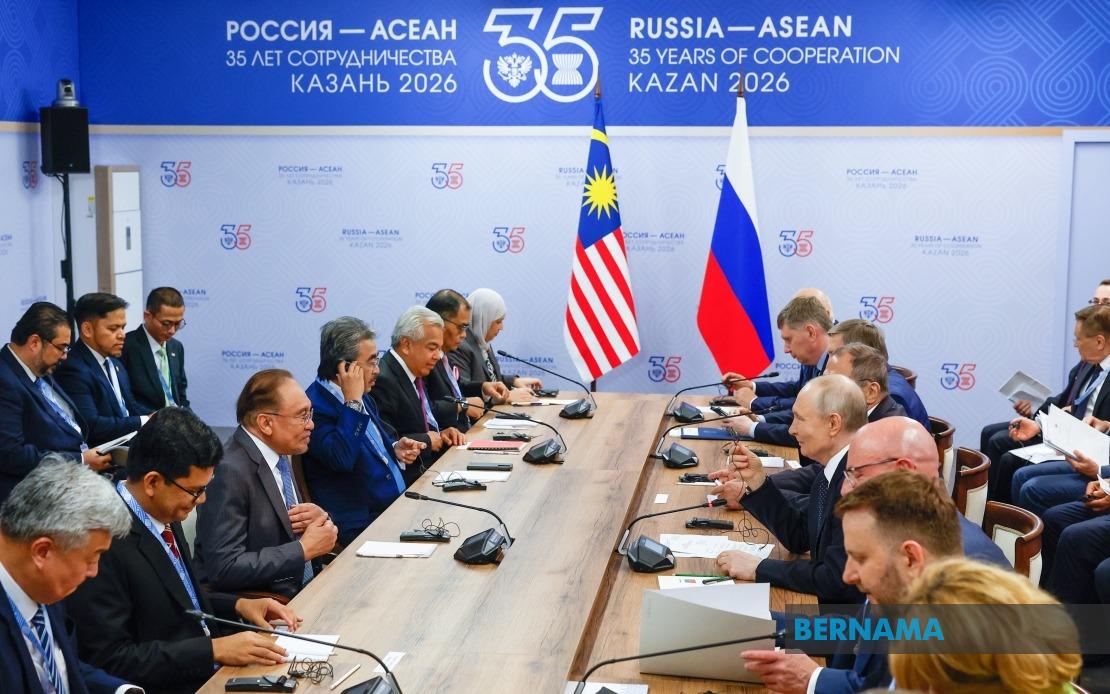
Russian President Vladimir Putin has affirmed that Russia and Malaysia possess solid groundwork to expand their bilateral relationship, as the two nations prepare to commemorate six decades of diplomatic engagement next year. During discussions with Malaysian Prime Minister Datuk Seri Anwar Ibrahim at the ASEAN-Russia Commemorative Summit in Kazan on June 18, Putin emphasised the maturity and substance underpinning the partnership between Moscow and Kuala Lumpur, noting that the countries have accumulated significant shared experience in official cooperation.
The Russian leader characterised the approaching 60th anniversary as an opportunity to build upon existing achievements rather than simply reflect on past accomplishments. Putin stressed that Russia and Malaysia have constructed what he termed "serious coordination" mechanisms designed to facilitate continuous expansion of their ties across multiple sectors. This positioning suggests both countries view their relationship not as a static arrangement but as one capable of meaningful deepening in the years ahead.
The institutional architecture supporting the Russia-Malaysia partnership reflects the seriousness both governments attach to their bilateral engagement. Putin highlighted the role of regular diplomatic contacts maintained through ministerial and parliamentary channels, which serve as ongoing forums for addressing shared concerns and identifying new cooperative opportunities. Beyond these formal structures, an intergovernmental commission focused on economic, scientific, technical and cultural collaboration has been tasked with translating high-level political commitments into tangible joint initiatives that yield practical benefits for both societies.
Economic performance provides concrete evidence of the relationship's vitality. Trade between Russia and Malaysia expanded by 12.9 per cent during 2025, a trajectory that Putin explicitly cited as evidence of the partnership's strength. For Malaysia, which historically has sought to maintain balanced economic relationships across multiple geopolitical spheres, this growth underscores the continued relevance of Russian trade partnerships despite the complex global environment. The expansion reflects demand for Russian commodities in the Malaysian market whilst simultaneously creating opportunities for Malaysian businesses seeking access to Russian consumers and supply chains.
Beyond trade figures, Putin identified education, science and technology, tourism and humanitarian exchanges as priority areas for expanded cooperation. These sectors carry particular significance for Southeast Asian nations like Malaysia, which have increasingly emphasised knowledge acquisition and human capital development as drivers of long-term economic competitiveness. Russian universities and research institutions have long attracted Malaysian students and scholars, whilst collaboration in technical fields could yield innovations applicable to both societies' development challenges. The emphasis on tourism and cultural ties also reflects recognition that people-to-people connections strengthen diplomatic relationships beyond what official channels alone can achieve.
Malaysia's role within ASEAN structures has enhanced its strategic importance to Russia. Putin acknowledged Malaysia's central position in facilitating closer Russia-ASEAN engagement, noting that the first summit-level meeting between Russia and ASEAN occurred in Malaysia in 2005. Malaysia's tenure as ASEAN Chair last year further elevated its profile as a bridge between Russia and the regional bloc. This positioning gives Malaysia considerable influence in shaping how ASEAN approaches relations with Moscow, a reality that carries implications for regional diplomacy across Southeast Asia during a period of heightened geopolitical competition amongst major powers.
The characterisation of Malaysia as a "long-standing global partner" suggests Putin views the relationship through a lens of historical continuity and strategic reliability. Russia has maintained diplomatic relations with Malaysia since 1964, providing two generations of bilateral engagement upon which to build. For Malaysia, Russia represents a significant non-Western power with which strategic autonomy can be demonstrated, particularly as Kuala Lumpur navigates complex relationships with the United States, China and other global actors. This multipolar approach to foreign policy aligns with Malaysia's broader principle of non-alignment and strategic flexibility.
The substance of Putin's remarks also carries significance for broader Southeast Asian dynamics. Russia's effort to strengthen ties with individual ASEAN members reflects Moscow's recognition that regional influence requires engagement at both the bloc and bilateral levels. Malaysia's receptiveness to deepening cooperation with Russia, as evidenced by hosting this high-level summit engagement, indicates that Kuala Lumpur continues to value relationships extending beyond traditional Western partnerships. This approach positions Malaysia as a balancer in regional geopolitics, neither fully aligned with any single great power nor entirely isolated from any.
Personal relationships amongst political leaders also feature prominently in Putin's remarks. His recall of previous meetings with Anwar Ibrahim and his conveyance of respect to His Majesty Sultan Ibrahim, King of Malaysia, underscore the personalised nature of diplomatic engagement at senior levels. In Asian political contexts, such acknowledgments carry weight beyond mere courtesy, reflecting acknowledgment of Malaysia's institutional structures and the respect with which Russia regards Malaysian leadership. The formal recognition of the Malaysian monarch signals that Russia understands and respects the constitutional role of the Sultan within Malaysia's political framework.
Looking forward, the 60th anniversary milestone presents an occasion for both countries to articulate their vision for the next phase of bilateral relations. For Malaysia, deepening ties with Russia offers opportunities to access Russian expertise, markets and technological capabilities whilst maintaining the strategic independence that characterises Malaysian foreign policy. For Russia, strengthening Malaysian engagement contributes to Moscow's efforts to build alternative partnerships and maintain diplomatic presence in Southeast Asia during a period when Western sanctions have complicated traditional partnerships. The bilateral relationship thus serves mutual strategic interests within a context of ongoing global competition for influence and alignment.
The timing of Putin's remarks at an ASEAN-Russia forum underscores the multilayered nature of contemporary regional diplomacy. Malaysia's ability to simultaneously engage Russia at bilateral level whilst maintaining ASEAN cohesion reflects the delicate balance Southeast Asian nations must strike. The organisation's centrality in regional architecture means that ASEAN-Russia relations depend substantially upon the willingness of individual member states to facilitate dialogue and cooperation. Malaysia's demonstrated commitment to this bridging role positions it as an essential node in the networks of regional engagement that define modern Southeast Asian geopolitics.