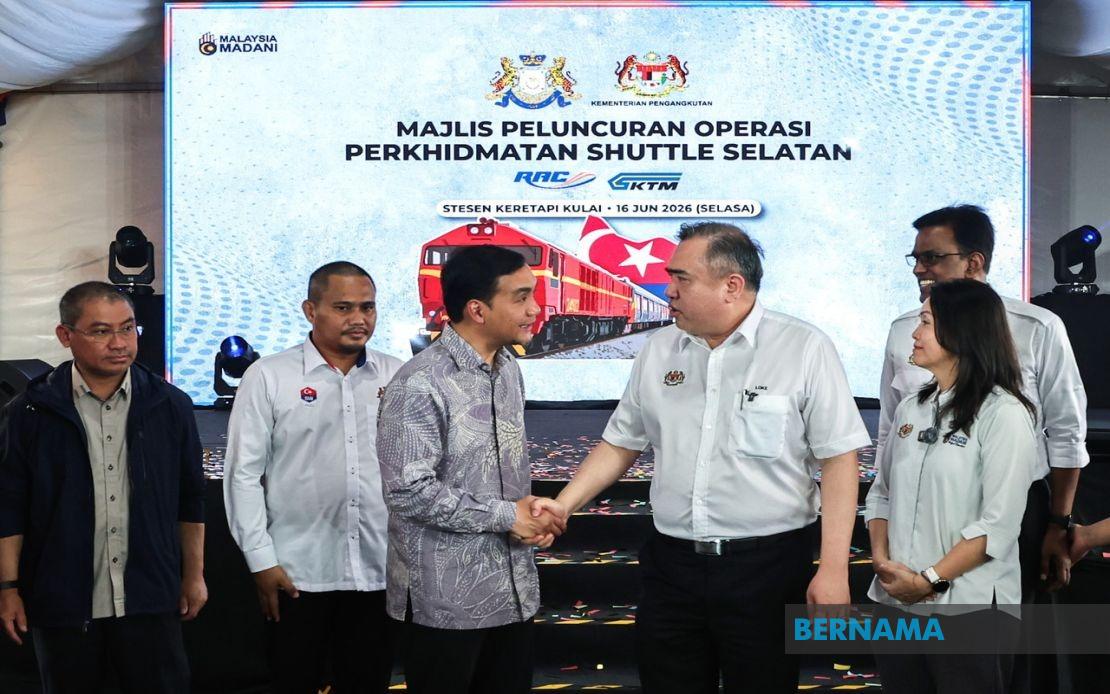
The newly launched Shuttle Selatan service represents a significant milestone in Johor's public transport development, with formal operations commencing at Kulai KTM station on June 16. Transport Minister Anthony Loke unveiled the service alongside Johor Menteri Besar Datuk Onn Hafiz Ghazi and other state officials, marking a collaborative effort between the Ministry of Transport, Keretapi Tanah Melayu Berhad and the Railway Assets Corporation to modernise regional connectivity in Malaysia's second-largest state.
The initial operating framework encompasses two primary routes designed to facilitate seamless movement between major urban and industrial hubs. The Kulai-JB Sentral-Kulai corridor offers passengers a 40-minute journey, whilst the Kempas Baru-Pasir Gudang-Kempas Baru route requires approximately 40 to 45 minutes of travel time. These journey durations represent a material improvement in transportation efficiency for commuters previously reliant on road-based alternatives, addressing long-standing connectivity challenges in the region that have constrained economic mobility and workforce accessibility.
Ministra Loke articulated an ambitious expansion strategy extending considerably beyond the current network. Plans include a comprehensive route extension from Paloh through Kluang, Renggam and Layang-Layang to Kulai, substantially broadening geographic coverage across southern Johor. Concurrently, three additional stations—Taman Daya, Bandar Baru Sri Alam and Pasir Putih—are under development to enhance accessibility and ensure that populations in emerging residential and commercial precincts benefit from rail-based infrastructure.
The service addresses a critical infrastructure gap in a state experiencing rapid economic expansion across multiple sectors. Johor's position as a fast-growing economic powerhouse, driven by expanding industrial parks, logistics hubs, port operations, educational institutions and trade corridors, demands modern public transport solutions that can accommodate burgeoning worker populations and facilitate efficient supply chain movements. Shuttle Selatan directly responds to these structural economic requirements by creating dedicated connectivity between residential catchment areas, commercial districts and major employment nodes.
Facilitating smooth first- and last-mile connectivity represents a cornerstone of the service design philosophy. The government has implemented coordinated supporting infrastructure including dedicated feeder bus services, integration with Bas.My route planning, a specialised shuttle service at Kempas Baru station, and park-and-ride facilities at AEON Bandar Dato' Onn. These complementary measures ensure that the rail service functions not in isolation but within a comprehensive mobility ecosystem addressing the complete end-to-end journey for commuters.
A distinctive incentive programme seeks to accelerate adoption of rail-based commuting among Johor residents. The Commuter MADANI Shuttle Selatan Card initiative distributed 3,000 complimentary travel cards to target populations, with each RM50 card enabling unlimited journeys for a designated period. This subsidy represents a meaningful financial incentive, with the Railway Assets Corporation allocating over RM150,000 to support mode shift from private vehicles and less efficient transport alternatives. Such direct financial inducements acknowledge psychological and behavioural barriers to public transport adoption and seek to establish usage patterns that become habitual.
The launch reflects broader national policy objectives centring on modal shift toward sustainable public transport systems. Malaysia's escalating urbanisation, congestion pressures and environmental imperatives necessitate investment in rail-based solutions that offer superior capacity, efficiency and environmental performance relative to private vehicle-dependent transport patterns. Shuttle Selatan demonstrates a willingness to deploy targeted infrastructure investment in secondary cities and regions beyond Kuala Lumpur, addressing historical geographic imbalances in public transport provision.
For Malaysian readers across the region, Shuttle Selatan illustrates emerging trends in state-level transport planning that prioritise connectivity between economic zones and residential areas. The service model—utilising existing KTM infrastructure, establishing dedicated shuttle operations and implementing integrated feeder networks—offers a replicable framework potentially applicable to other high-growth corridors throughout Malaysia experiencing similar connectivity and capacity challenges.
The projected beneficiary population exceeding two million individuals underscores the potential scale and significance of this initiative. If realised, this would represent penetration across a substantial portion of Kulai, Johor Bahru and Pasir Gudang populations, with transformative implications for commute patterns, employment accessibility and quality of life metrics across these municipalities. Success will depend substantially on service reliability, frequency optimisation and sustained promotion to entrench public confidence and usage behaviour.
Looking forward, the announced expansion trajectory suggests continued government commitment to progressive enhancement of rail connectivity across Johor. The multi-phased development approach—launching core routes, establishing supporting infrastructure, planning route extensions and introducing incentive programmes—reflects a structured implementation strategy rather than ad-hoc service provision. This methodical advancement indicates recognition that sustainable public transport adoption requires sustained investment, coordination and policy consistency beyond initial launch periods.
The service operationalisation also demonstrates increasingly sophisticated integration between various transport operators and government agencies, with coordination between KTMB, RAC, municipal authorities and transport ministries proving essential to successful implementation. Such institutional arrangements become increasingly important as transport networks grow more complex and interdependent, requiring seamless data sharing and operational synchronisation across previously siloed organisations.