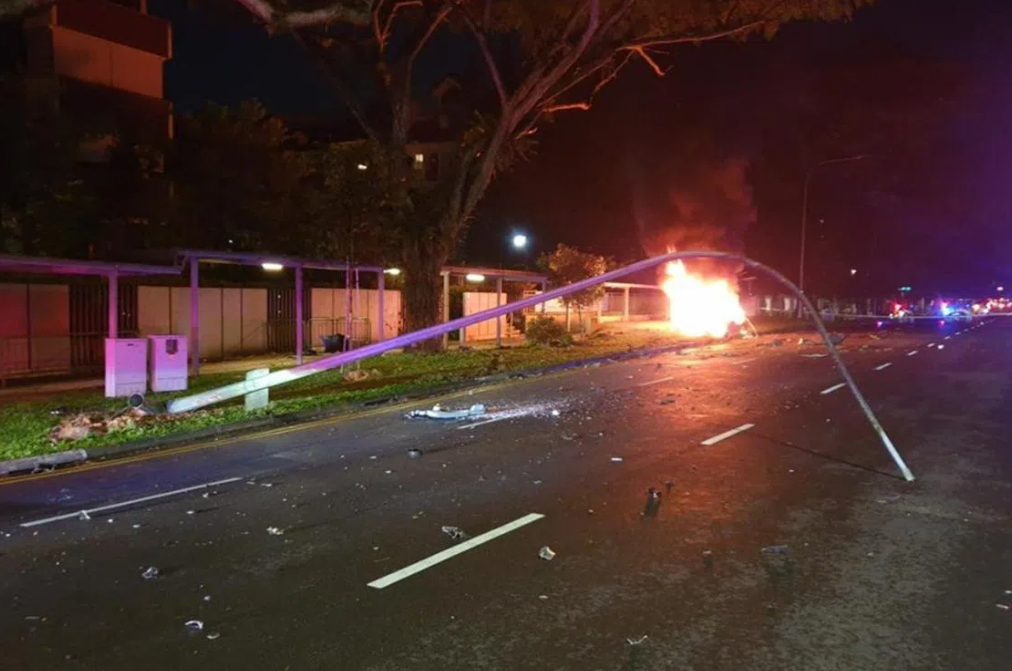
A serious traffic incident in Singapore has resulted in multiple charges against a 29-year-old man who allegedly drove recklessly while impaired, narrowly avoiding catastrophe when his vehicle collided with a bus carrying children. Aaron Tan Yao Cong now faces five separate charges relating to the March 6, 2024 incident, which unfolded across two separate phases of dangerous driving culminating in a fiery crash.
The events began early on that morning when Tan allegedly violated traffic directions along Cavenagh Road near Bukit Timah, deliberately negotiating a left bend to drive directly into oncoming traffic rather than proceeding straight as instructed. Court documents reveal he came to a complete stop on the left side of the two-lane roadway, where he and three passengers initially remained in the vehicle. What makes this opening sequence troubling is that it demonstrates deliberate disregard for basic traffic control measures and the safety of other motorists who would have been forced to react suddenly to his presence.
The situation escalated dramatically when police officers approached the stationary vehicle at approximately 6 o'clock in the morning. Rather than cooperating with authorities, Tan accelerated away and embarked on a high-speed chase through early morning traffic. Between 6:10 and 6:16 am, officers tracked him along Bukit Timah Road towards Upper Bukit Timah Road, where he maintained an average speed of 114 kilometres per hour while weaving erratically between other vehicles. During this period, he failed to comply with traffic signals and drove recklessly at a junction between Coronation Road and Anamalai Avenue.
The dangerous journey concluded at the intersection of Sixth Avenue when Tan disregarded a red traffic light and collided head-on with a private bus that was executing a U-turn. The impact was severe enough to send his vehicle into a nearby lamp post, causing it to catch fire immediately. All occupants of both vehicles required hospitalisation, with particular concern for two young passengers on the bus, aged nine and ten, who sustained injuries necessitating medical treatment. The incident underscores how reckless individual decisions can endanger vulnerable road users, especially children who depend entirely on the safety practices of other motorists.
Testing conducted after Tan's arrest revealed why his driving was so erratic. His blood alcohol content measured 148 milligrams per 100 millilitres, substantially exceeding Singapore's legal limit of 80 milligrams per 100 millilitres. More concerning for prosecutors was his initial refusal to submit to a breathalyser test, which itself constitutes a separate criminal charge. This resistance to testing is significant because it suggests conscious awareness of his impaired state, which prosecutors can use to demonstrate culpability and intent.
What particularly aggravates Tan's legal position is that this was not his first encounter with drink-driving offences. Court records show he was previously convicted of drink driving and driving without due care and attention in 2019, meaning he is now a repeat offender facing enhanced penalties. His demonstrated inability to learn from previous consequences, despite legal intervention, raises serious questions about deterrence effectiveness and whether alternative measures might be necessary for chronic traffic safety violators.
Tan was formally charged on Thursday, June 18 with five offences: drink driving, dangerous driving causing hurt, leaving a vehicle in a position likely to cause danger to other road users, failing to cooperate with a breath specimen test, and driving against the flow of traffic. At an initial court appearance, he did not indicate whether he intended to plead guilty to any of the charges, reserving his defence strategy for the substantive hearing scheduled for July 16.
The potential penalties Tan faces reflect Singapore's strict approach to traffic safety violations. For drink driving as a repeat offender, he could receive up to two years imprisonment and a fine reaching S$20,000. The dangerous driving charge carries imprisonment of up to two years with a fine up to S$10,000, or both, with repeat offenders facing up to S$20,000 in fines. For allowing his vehicle to be positioned dangerously, three months imprisonment or S$1,000 in fines are possible, while refusing the breathalyser test could result in six months jail and S$5,000 in fines for repeat offenders, escalating to S$10,000. Finally, driving against traffic could mean three months jail and S$1,000 fine, or six months and S$2,000 for repeat offenders.
The case reflects broader road safety challenges in Singapore and the region. Despite consistent public education campaigns and legal frameworks, impaired driving continues to pose serious risks, particularly when combined with dangerous driving behaviours. The incident demonstrates how a single individual's poor judgment can simultaneously endanger multiple innocent parties, from the bus driver performing routine duties to young children whose safety depends on the responsibility of surrounding motorists.
For Malaysian readers, the incident serves as a cautionary reminder about enforcement priorities and sentencing frameworks. While Malaysia has strengthened drink-driving laws significantly in recent years, inconsistent enforcement and variable sentencing across jurisdictions remain challenges. Singapore's approach of mandatory testing and graduated penalties for repeat offenders offers a comparative model worth considering, particularly regarding how jurisdictions can interrupt patterns of dangerous behaviour before serious injury or fatality occurs.
The collision with the school bus carrying children adds a particularly troubling dimension to the case, as it illustrates how impaired and reckless driving disproportionately affects vulnerable road users who cannot protect themselves. Both Singaporean and Malaysian authorities have emphasised protecting children through initiatives targeting school bus safety, yet incidents like this demonstrate that driver behaviour remains the critical variable in preventing tragedies.
Pending trial, Tan remains subject to the court's jurisdiction, and his case will likely receive significant attention given the involvement of injured children and the severity of charges. The outcome may influence future prosecutorial strategies for similar cases involving repeat offenders and will contribute to ongoing judicial interpretation of proportionate sentencing for compound traffic offences.