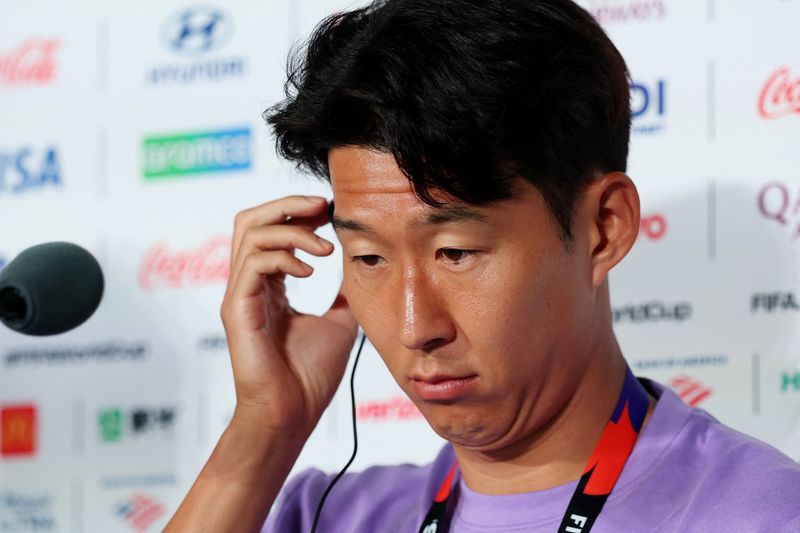
South Korea's national football team has taken the unusual step of withdrawing from voluntary media duties during the World Cup after what the Korea Football Association describes as inappropriate remarks about captain Son Heung-min's military service. The controversy erupted when reporters from South Korean media outlets were caught on an open microphone making derisive comments about the 33-year-old Tottenham Hotspur forward while he was training separately from his teammates at the team's Guadalajara base camp.
The incident highlights the fraught relationship between South Korea's sports establishment and domestic media, particularly on matters concerning military service—a deeply sensitive subject in a country divided since 1950. The KFA moved swiftly to address the situation, releasing a statement expressing regret over what it termed "inappropriate remarks made by some media personnel." The federation framed the boycott as a necessary protective measure, emphasizing that the players remain committed to representing their nation with dignity on sport's biggest stage.
Military conscription in South Korea is a non-negotiable civic obligation for all able-bodied men, requiring approximately 21 months of service to maintain the country's defence posture against North Korea. This mandatory requirement has shaped national discourse for decades and remains a flashpoint whenever public figures are involved. However, South Korean law does provide exemptions for athletes who achieve major international success, specifically those who win medals at the Olympic Games or titles at the Asian Games.
Son Heung-min and his teammates earned their exemption from full military service through their triumph at the 2018 Asian Games in Indonesia, where South Korea's U-23 football team captured the gold medal. Despite this achievement, Son was still required to complete a three-week basic military training programme, which he undertook in 2020 when the Premier League paused operations due to the COVID-19 pandemic. This training was notably rigorous, exposing participants to tear gas, live-fire exercises, and demanding physical challenges including 30-kilometre hikes.
The KFA's statement revealed the depth of the team's distress, noting that the leaked inappropriate conversations had caused "great shock and disappointment" within the squad. The federation positioned the boycott as an exercise in protecting the athletes' mental and emotional wellbeing during a crucial tournament while they attempted to meet the expectations of South Korean supporters. The KFA explicitly called on media outlets to demonstrate "greater consideration and a responsible attitude" towards the national team, signalling that the association would not tolerate similar behaviour.
Despite this dispute, the South Korean team will not be able to maintain an indefinite media boycott. FIFA's regulations mandate that participating nations conduct certain media responsibilities as a condition of World Cup participation. This means that while the squad may have withdrawn from voluntary press engagements, they will ultimately be required to fulfil the tournament's mandatory media obligations. This creates a delicate balancing act between the team's desire to protect its players and the governing body's requirement for media access.
The controversy underscores broader tensions within South Korean society regarding military service and how public figures are expected to handle this patriotic duty. For many South Koreans, military service remains a defining experience that shapes character and demonstrates national commitment, making jokes about it particularly inflammatory. Son's status as one of Asia's most recognisable footballers adds another dimension to the sensitivity; his image is scrutinised constantly both domestically and internationally, and any perceived disrespect to his military service is seen by supporters as a slight against the nation itself.
The incident also reflects the intense pressure placed on South Korean athletes representing their country on the global stage. Unlike in many Western nations where military service is optional or does not apply to athletes, South Korean players carry the weight of this civic responsibility alongside their sporting aspirations. The mockery documented in this incident essentially weaponised a patriotic duty against a player, transforming his compliance with national law into grounds for ridicule—a move that many observers view as deeply unpatriotic.
For regional observers in Southeast Asia, the incident provides insight into South Korea's unique political and social pressures that influence sports. The divide between the two Koreas remains a defining feature of South Korean life, affecting everything from conscription policies to how athletes are expected to represent their nation. While Southeast Asian nations have their own complex relationships with military service and national pride, few are shaped by such an immediate existential security concern.
The KFA's commitment to maintaining a "healthy media environment" signals its intention to set clearer boundaries between legitimate sports journalism and personal attacks on athletes. This could set precedents for how other Asian federations manage relations with domestic media, particularly when sensitive national issues intersect with professional sports. The case demonstrates that protecting player welfare is increasingly viewed as a federation's responsibility, not merely a matter of individual athlete resilience.
Looking forward, the resolution of this dispute may shape how South Korean media covers the national team throughout the tournament. The public rebuke from the KFA, supported by the players' united response, has effectively reset expectations about acceptable discourse. Whether this leads to meaningful structural reforms in how South Korean media covers the squad—or represents merely a temporary cooling-off period—remains to be seen as the team progresses through the competition.