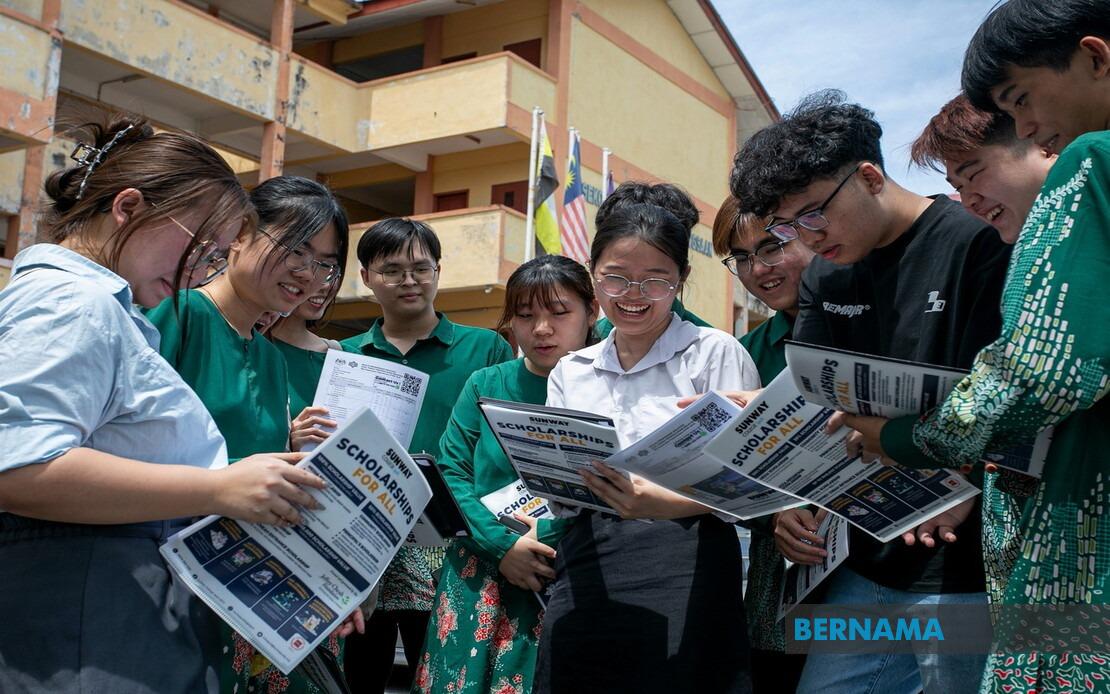
The Malaysian Examinations Council highlighted the enduring strength of the Sijil Tinggi Persekolahan Malaysia (STPM) qualification as a legitimate and competitive alternative to international pathways, drawing evidence from three exceptional students whose achievements underscore the breadth of opportunity within the Form Six system. The trio's success, recognised at the council's headquarters in Kuala Lumpur on June 18, illustrates how STPM continues to serve students from marginalised communities, economically disadvantaged backgrounds, and those facing physical barriers to education—a critical dimension often overlooked in debates about Malaysia's pathways to higher learning.
Hazaril Hakimi Hassan, an Orang Asli student from Kampung Paya Mendoi in Kuala Krau, Pahang, attained a perfect 4.00 Cumulative Grade Point Average, becoming a tangible example of how Form Six reaches populations historically underrepresented in higher education corridors. His journey from a rural indigenous community to academic excellence reveals a crucial truth: that potential exists across all demographic strata, yet institutional awareness and family encouragement remain pivotal determinants of whether promising students choose STPM over other routes. Hassan's decision to pursue Malay Language Education at Universiti Putra Malaysia, with aspirations toward an academic career, represents not merely individual ambition but a form of social mobility rooted in accessible, domestically grounded qualifications.
The affordability factor, frequently cited but rarely quantified in public discourse, emerged as a decisive consideration for Hassan and his peers. Where international qualifications such as the International Baccalaureate or A-levels demand substantial financial outlay—costs prohibitive for rural and lower-income families—STPM operates within Malaysia's public education infrastructure, dramatically reducing barriers to entry. This structural advantage becomes particularly significant given that Malaysia's income inequality and regional disparities mean that talented students in Pahang, Kelantan, or Terengganu face vastly different resource availability than their counterparts in Kuala Lumpur or Petaling Jaya.
Ng Yu Yong, from SMK Tsung Wah in Kuala Kangsar, Perak, achieved five distinctions including in Physics and Biology, positioning himself for a Bachelor of Medicine and Bachelor of Surgery degree at Universiti Malaya. His advocacy for STPM as the optimal choice for students pursuing medical careers carries particular weight, as it challenges a widespread perception that local qualifications disadvantage applicants seeking places in competitive professional programmes. Ng's explicit recommendation that younger students select Form Six as a platform for academic excellence—rather than viewing it as a fallback option—inverts the narrative that has gradually eroded STPM's standing in recent years as middle-class families increasingly opt for international curricula.
The international recognition argument, though sometimes dismissed, remains substantive. STPM holders maintain access to universities across the Commonwealth and beyond, as well as competitive pathways into regional institutions across Southeast Asia, Hong Kong, and further afield. This portability, combined with domestic acceptance, provides STPM students with optionality that rigidly international-focused trajectories cannot guarantee. For families uncertain about overseas prospects or unable to finance extended periods abroad, STPM allows pursuit of international-standard education without complete geographic relocation.
Perhaps most revealing was the experience of Yeoh Chwen Yih, a visually impaired student from St John's Institution, who attained a 4.00 CGPA and intends to pursue law. Yeoh's recognition that Form Six provided a more inclusive learning environment than available alternatives speaks to systemic accessibility challenges within Malaysia's education sector more broadly. The integration of screen-reading technology within STPM curricula, enabling faster access to learning materials than Braille alternatives, demonstrates how institutional design can either compound or mitigate disadvantage. For students with disabilities—a demographic numbering in the tens of thousands across Malaysia—such practical considerations often determine whether particular pathways remain viable.
Yeoh's trajectory toward legal studies reflects a broader pattern wherein STPM produces graduates across diverse professional disciplines: medicine, law, education, engineering, and the sciences. This disciplinary breadth counters arguments that STPM produces only generalists or feeds exclusively into teaching pipelines. The qualification's flexibility accommodates both vocationally specific and academically exploratory students, allowing adolescents uncertain about final direction to maintain breadth while specialising sufficiently to meet university prerequisites.
The timing of these recognition ceremonies carries policy implications. As Malaysia navigates ongoing discussions about education reform, international competitiveness, and social mobility, evidence that STPM concurrently delivers academic rigour and inclusivity becomes instrumentally valuable. The qualification's existence within public infrastructure means that its strength or decline directly affects the opportunity structures available to millions of secondary students who cannot access or afford private schooling or overseas education.
For Southeast Asian context, Malaysia's STPM serves as a regional model—a domestically embedded qualification that maintains international credibility while remaining affordable to lower-income students. Countries across the region grapple with similar tensions between ensuring local accessibility and pursuing international standards; STPM's demonstrated capacity to balance these objectives warrants study by neighbouring education systems.
The Malaysian Examinations Council's decision to elevate these three achievers reflects implicit acknowledgment that STPM's competitive standing requires active articulation and visibility. Perception substantially determines educational choice; when high-performing students from privileged backgrounds gravitate toward international qualifications, remaining STPM cohorts become incrementally less diverse, potentially triggering a self-fulfilling prophecy wherein the qualification's perceived prestige declines alongside demographic shifts. Conversely, visible success among students from backgrounds typically excluded from elite educational pathways strengthens STPM's narrative as a mechanism for genuine meritocratic advancement rather than a remedial option for those unable to afford superior alternatives.
Moving forward, sustained promotion of STPM's accessibility, affordability, and academic validity may prove essential for reversing gradual erosion of enrolment among aspirational families. The three 2025 achievers—an indigenous student from rural Pahang, a working-class student from provincial Perak, and a visually impaired student navigating systemic barriers—collectively embody STPM's unrealised potential as a genuinely inclusive gateway to professional and academic excellence.