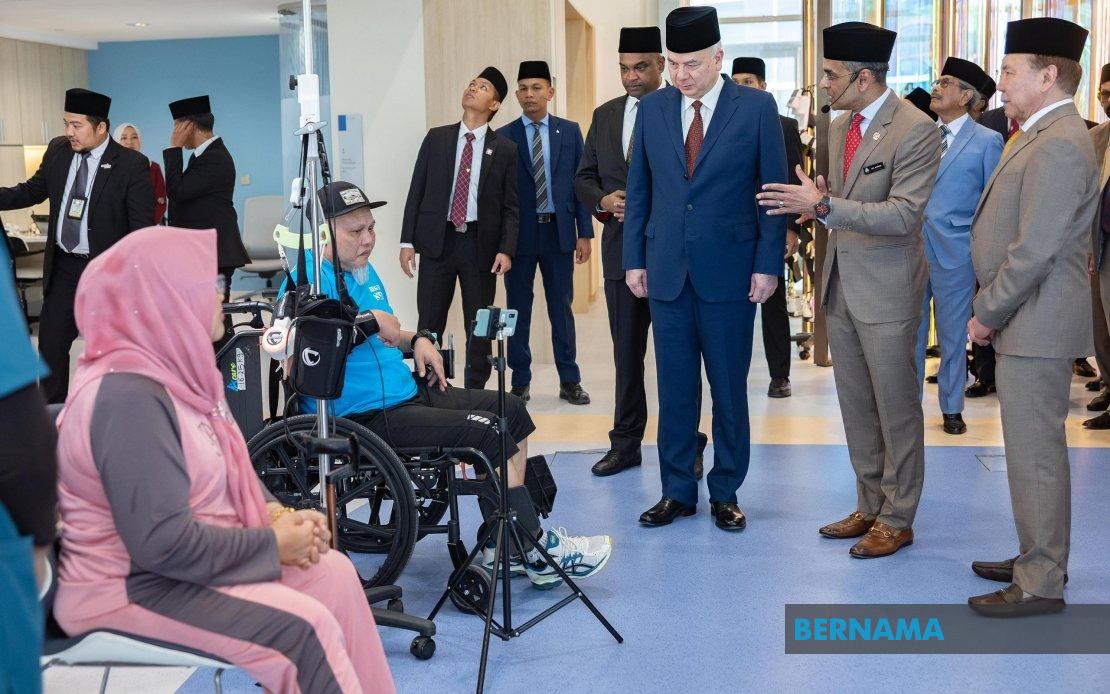
Sultan Nazrin Shah, the Sultan of Perak, officially opened the Social Security Organisation's (PERKESO) Neuro-Robotics and Cybernetics Rehabilitation Centre in Meru Raya on June 16, marking a transformative moment for Malaysia's approach to disability rehabilitation and worker welfare. The facility, which will now bear the name "Pusat Rehabilitasi Perkeso Sultan Nazrin Shah," integrates cutting-edge technology with compassionate care to support individuals recovering from neurological injuries and disabilities. The architectural design of the centre draws inspiration from traditional gold-thread embossing, a nod to Malaysia's cultural heritage, while its interior reflects the most contemporary advances in medical rehabilitation science.
The opening ceremony was attended by prominent state dignitaries, including Raja Muda Perak Raja Jaafar Raja Muda Musa and Raja Di Hilir Perak Raja Iskandar Dzulkarnain Sultan Idris Shah. Minister of Human Resources Datuk Seri R. Ramanan and Menteri Besar Datuk Saarani Mohamad were also present, underscoring the national significance of the initiative. The gathering reflected both state and federal commitment to advancing rehabilitation infrastructure, a priority that speaks to broader regional concerns about supporting workers whose livelihoods are disrupted by health crises.
In his keynote address, Sultan Nazrin articulated a vision of rehabilitation that extends beyond medical treatment to encompass human dignity and societal responsibility. He emphasised that the centre's true value resides not merely in its technological sophistication but in the collective expertise and genuine compassion of the multidisciplinary teams operating within it. The facility brings together medical specialists, engineers in assistive technology, physiotherapists, occupational and vocational therapists, social workers, and psychologists—a comprehensive approach that recognises rehabilitation as fundamentally holistic rather than purely medical in nature.
The Sultan framed the centre as embodying a philosophical shift in how Malaysia conceptualises disability and recovery. Rather than viewing rehabilitation as a technical problem requiring only clinical intervention, he presented it as an expression of national values centred on human worth and collective responsibility. This rhetorical positioning is significant for Malaysia's continuing development of social welfare frameworks, particularly as the country navigates the tension between economic advancement and ensuring that progress includes the most vulnerable populations. His statement that "true progress lies in a nation's ability and determination to introduce and implement social programmes that preserve human dignity, protect the vulnerable and provide a second chance" challenges purely GDP-focused development metrics.
The centre's establishment traces back to an initiative launched by M. Kulasegaran, the Member of Parliament for Ipoh Barat, during his tenure as Minister of Human Resources from 2018 to 2020. This institutional memory is relevant for understanding Malaysia's policy continuity across different administrations—the facility represents sustained commitment to disability rehabilitation even as political configurations have shifted. The Sultan acknowledged this genesis, recognising that transformative social infrastructure often requires years of advocacy and planning before materialising into operational centres serving the community.
Sultan Nazrin articulated specific scenarios illustrating how the centre addresses distinct rehabilitation pathways. For stroke survivors, the facility offers intensive physiotherapy and neuro-robotics to restore motor function and mobility. Workers recovering from neurological injuries benefit from both medical treatment and psychological support to rebuild mental resilience. Those affected by traumatic brain injuries access speech therapy, cognitive rehabilitation, and memory recovery programmes. By presenting these concrete applications, the Sultan moved beyond abstraction to demonstrate tangible ways the centre will alter recovery trajectories for individuals and families facing devastating health crises. This specificity is particularly resonant for Malaysian audiences, many of whom have family members affected by stroke, occupational injuries, or accidents resulting in neurological damage.
A crucial dimension of Sultan Nazrin's remarks concerned employment reintegration following rehabilitation. He specifically commended PERKESO's partnership with 7-Eleven, which provides post-rehabilitation workplace training and potential employment pathways. This collaboration addresses a critical gap in Malaysia's disability support ecosystem: the transition from medical recovery to economic independence. Without viable employment opportunities, even successfully rehabilitated individuals face psychological setbacks and return to dependency. The Sultan's call for expanded private sector engagement through corporate social responsibility initiatives, vocational training programmes, and hiring commitments represents a pragmatic strategy for moving beyond medical rehabilitation toward sustainable social and economic reintegration.
The Sultan's exhortation to eliminate societal prejudice toward persons with disabilities carries particular weight given prevailing discriminatory attitudes in many Malaysian workplaces. His emphasis that "every life is valued, every worker matters and every family is important" serves both as moral instruction and implicit recognition that disability discrimination remains entrenched in hiring practices and workplace culture. By articulating this message from the throne, Sultan Nazrin lends significant symbolic weight to calls for attitudinal change, potentially influencing corporate leaders and policymakers listening to or reading coverage of his remarks.
The centre's architectural inspiration from traditional gold-thread embossing is more than aesthetic choice; it symbolises intentionality in blending cultural heritage with technological modernity. This design philosophy resonates with Southeast Asian efforts to maintain cultural identity while embracing globalised medical advancement. Malaysia, like its neighbours, often faces pressure to adopt wholesale Western models of healthcare and rehabilitation. The deliberate integration of traditional artistic elements suggests a different path—one that leverages world-class technology while remaining rooted in local cultural expression.
The facility's establishment reflects broader regional trends in disability rehabilitation infrastructure across Southeast Asia. Malaysia joins countries like Singapore and Thailand in investing substantially in neuro-rehabilitation technology. However, Malaysia's integration of PERKESO's employment support functions within the rehabilitation ecosystem represents a distinctive approach focusing on post-recovery economic independence. This model may offer valuable lessons for neighbouring countries developing their own rehabilitation frameworks, particularly those with similar informal employment sectors and limited social safety nets.
Looking forward, the centre's success will depend on sustained funding, continuous staff training in rapidly evolving technologies, and—critically—meaningful collaboration with employers willing to hire rehabilitated workers. The Sultan's implicit acknowledgment that this represents a collective social responsibility rather than purely government obligation signals recognition that Malaysia's disability rehabilitation cannot succeed without comprehensive ecosystem transformation. The challenge now extends beyond the centre's walls to encompass workplace culture change, policy reforms facilitating employment of persons with disabilities, and sustained public investment in rehabilitation capacity.
The opening of Pusat Rehabilitasi Perkeso Sultan Nazrin Shah represents an institutional commitment to the principle that adversity need not define one's entire life trajectory. For Malaysia's evolving welfare state, it marks recognition that true development encompasses supporting those whose labour market participation has been disrupted by health crises. As the nation continues navigating demographic ageing and occupational health challenges, such facilities become increasingly essential infrastructure—not merely for humanitarian reasons, but as strategic investments in maintaining a productive, inclusive workforce capable of contributing to national economic objectives while preserving fundamental human dignity.