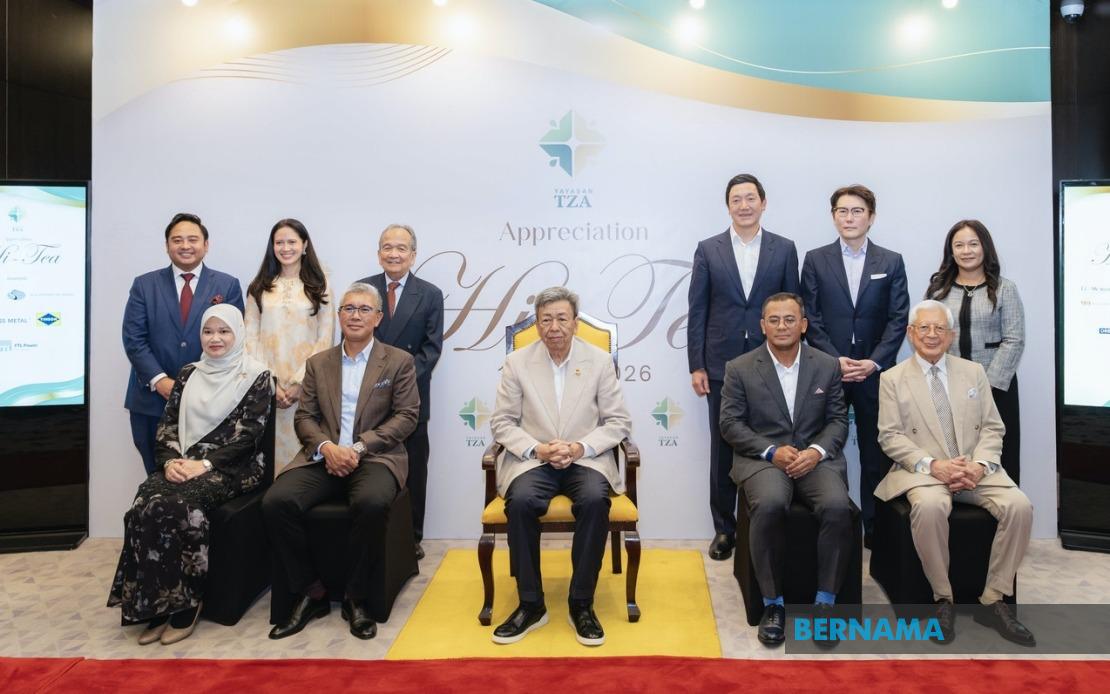
The Sultan of Selangor, Sultan Sharafuddin Idris Shah, lent his patronage to Yayasan TZA's appreciation hi-tea ceremony in Kuala Lumpur on June 18, signalling sustained royal backing for the foundation's social welfare work across the state. The afternoon gathering drew prominent government figures including Selangor Menteri Besar Datuk Seri Amirudin Shari and Federal Education Minister Fadhlina Sidek, underscoring the political weight attached to the foundation's educational initiatives.
Tengku Datuk Seri Zafrul Abdul Aziz, serving as YTZA's advisor, outlined a comprehensive philosophy during his remarks that positions the foundation as more than a stopgap measure for immediate poverty. Rather, he framed YTZA's portfolio as deliberately structured to foster long-term capability within disadvantaged communities—combining academic support with sustainability projects and outreach programmes designed to create pathways toward self-reliance and dignity. This multilayered approach reflects growing sophistication among Malaysian philanthropic organisations in moving beyond traditional charity models toward systemic empowerment.
The foundation's flagship ACE SPM programme represents a direct response to persistent educational disparities affecting lower-income households. By targeting Form Five students from B40 (bottom 40 per cent income) backgrounds, the initiative addresses a critical juncture where many Malaysian youth from marginalised families either fail to complete secondary education or enter the workforce underprepared for tertiary study or skilled employment. During 2025 alone, the programme enrolled 467 students across 10 Selangor schools, demonstrating meaningful penetration within the state's education ecosystem.
Where ACE SPM gains particular traction is through its digital dimension, which reached more than 4,000 students and represents a strategic pivot toward technology-enabled learning that transcends geographic and socioeconomic barriers. This hybrid approach—combining in-person tutoring with online resources—has become essential in a post-pandemic education landscape where digital literacy itself functions as a prerequisite for advancement. For rural or geographically dispersed B40 communities, such digital access can meaningfully narrow the preparation gap that typically disadvantages poorer students taking the SPM examination.
The financial commitments secured during the ceremony demonstrate robust corporate engagement with the foundation's mission. Kuok Brothers Sdn Bhd pledged RM1 million while YTL Power International Berhad contributed RM300,000, totalling RM1.3 million in fresh capital. Such donations signal that Malaysian conglomerates increasingly view targeted educational philanthropy as compatible with shareholder value and corporate social responsibility expectations—a positive sign for the sustainability of social programmes that depend on private sector partnership.
Tengku Zafrul's explicit gratitude toward sponsors, donors, volunteers and partners acknowledged the ecosystem dependency underlying such work. Malaysian philanthropic success rarely flows from foundation effort alone; rather, it emerges through networks of corporate partners, individual volunteers, government alignment and strategic collaborators who collectively amplify impact. The recognition of these stakeholders during a high-profile event attended by state leadership reinforces the notion that supporting YTZA's work carries prestige and alignment with official priorities.
The foundation's launch of Larian KITA@Klang, scheduled for October 10, extends its community engagement beyond purely educational domains into the cultural and wellness sphere. Planned to coincide with the Sultan of Selangor's Silver Jubilee celebration, the community fun run represents the foundation's fourth iteration in the Larian KITA series and signals intentional efforts to build inclusive public events that celebrate diversity while promoting community cohesion. For Selangor residents, such activities provide low-barrier entry points to organised civic participation.
The convergence of these initiatives—academic support, digital learning, corporate fundraising and community activation—indicates that YTZA operates according to an integrated theory of social change rather than ad-hoc charitable distribution. This sophistication matters for Malaysian donor prospects and government observers evaluating philanthropic effectiveness. Foundations that combine measurable educational outcomes with broader community-building activities tend to attract sustained support because they demonstrate resilience across multiple impact vectors.
For Southeast Asian observers, YTZA's approach offers instructive lessons about scaling social programmes within middle-income economies where government capacity remains uneven and private wealth accumulates but often lacks coordinated deployment mechanisms. The foundation's partnership with education authorities, corporate entities and royal institutions creates a governance structure that balances autonomy with legitimacy—a template increasingly replicated across the region as social challenges outpace state capacity.
Moving forward, YTZA's stated commitment to expand ACE SPM and deepen its geographic reach hinges on sustained fundraising momentum and the continued alignment of corporate interests with educational equity objectives. The presence of federal and state leadership at the ceremony suggests government receptiveness to such programmes as complements to public education expenditure. For Malaysian families in lower-income brackets, such private-sector educational support increasingly functions as essential supplementary infrastructure—a reality that underscores both the potential and the limitations of relying on philanthropic initiatives to address systemic educational inequality.