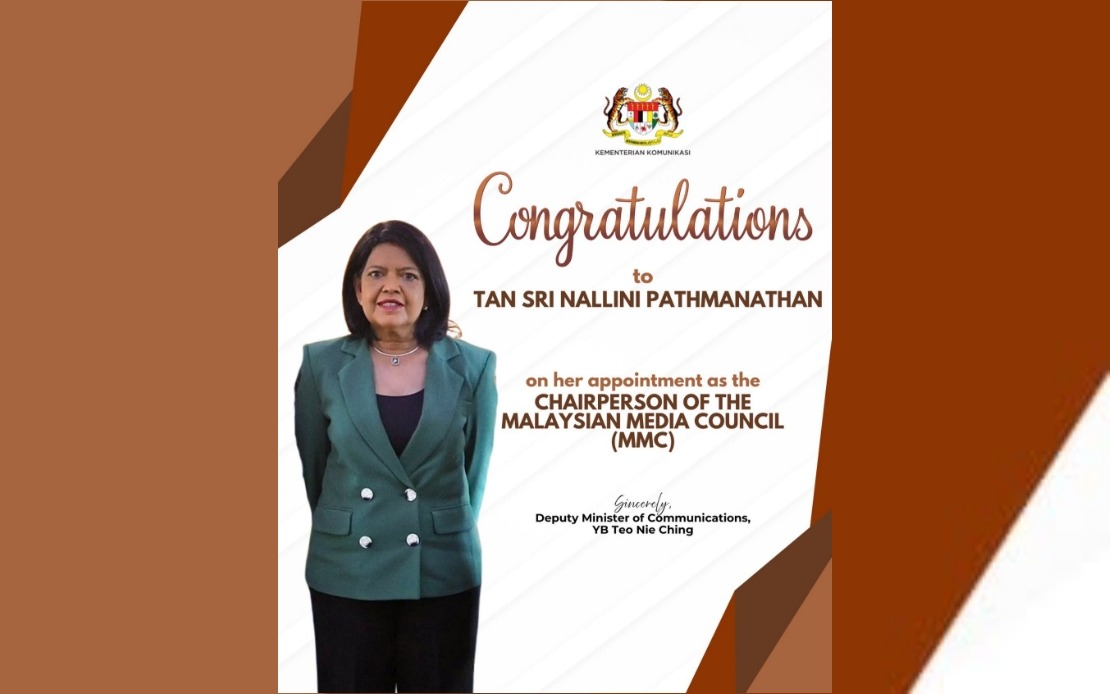
The appointment of former Federal Court judge Tan Sri Nallini Pathmanathan as chairperson of the Malaysian Media Council has received public backing from Deputy Communications Minister Teo Nie Ching, who highlighted the jurist's long-standing commitment to press freedoms and constitutional protections. Speaking through a Facebook post, Teo expressed unwavering confidence in Nallini's capacity to steer the council toward becoming a truly independent and robust self-regulatory institution for Malaysia's media landscape. The endorsement carries weight given Teo's position within the communications ministry and her familiarity with the sector's complexities and challenges.
Teo's support centres on Nallini's demonstrated judicial philosophy throughout her career on the bench. The Deputy Minister specifically referenced a narrow 4-3 split decision concerning Malaysian citizenship rights for children born to a Malaysian father and a foreign mother, where Nallini authored a dissenting judgment that advocated for a more purposive and compassionate reading of the nation's constitutional citizenship provisions. This judgment exemplified what Teo characterised as Nallini's forward-thinking legal perspective and her ability to balance strict textual interpretation with humanitarian concerns, qualities that Teo believes will prove invaluable in leading a media self-regulatory body.
Another landmark case cited by Teo involved a significant online news portal. In that matter, Nallini dissented from the majority, ruling that news portals should not bear liability for comments posted by their subscribers on the platform. This judgment touches directly on issues central to modern media regulation: the tension between holding publishers accountable and protecting editorial freedom, as well as the distinction between a platform's own content and user-generated material. Such nuanced thinking on digital media issues suggests Nallini brings practical understanding of contemporary journalism challenges to her new role.
The Malaysian Media Council itself represents a watershed moment for Malaysia's media ecosystem. Established under the Malaysian Media Council Act 2025, the council fulfils a goal that stakeholders and advocacy groups have pursued for half a century. Five decades of sustained campaigns, formal petitions, and policy discussions finally culminated in the creation of this self-regulatory body, marking a significant structural development for the industry. The MMC Board unanimously endorsed Nallini's appointment at a meeting held on 26 May, indicating broad consensus among board members about her suitability for the role.
Teo's statement underscores the philosophical importance of self-regulation in a democratic media ecosystem. She emphasised that journalists occupy a distinctly vital position within society—functioning as what she termed the Fourth Estate of democracy. This classical conception of the press as an essential check on power and promoter of public accountability means that media freedom cannot be treated as merely another sectoral concern. Rather, it represents a foundational democratic institution that requires careful protection and appropriate institutional arrangements.
Crucially, Teo argues that state-directed intervention in media affairs, regardless of intent, inherently risks appearing as an infringement on editorial independence and broader press freedom. This sensitivity reflects Malaysia's media landscape, where questions about government influence have historically surfaced during discussions of regulatory frameworks. The establishment of a self-regulatory council sidesteps this fundamental legitimacy problem by positioning industry participants themselves as stewards of professional standards. Such an arrangement, Teo maintains, is not merely preferable but absolutely necessary given the distinctive constitutional and democratic role the press plays.
The timing of Nallini's appointment coincides with the formal launch of MMC operations following the legislation's enactment. As the inaugural chairperson, she will shape the council's operational culture, institutional priorities, and approach to resolving complaints or addressing industry conduct issues. Her judicial background equips her with experience navigating complex legal frameworks, interpreting statutes, and producing reasoned decisions that can withstand scrutiny. These capabilities directly translate to the governance challenges a media council must address.
For Malaysian journalism and media stakeholders, Nallini's appointment signals an institutional shift toward a self-regulatory model that emphasises professional autonomy rather than external oversight. This represents a departure from previous eras when media governance relied more heavily on statutory regulation and government oversight mechanisms. The self-regulatory approach potentially offers journalists greater freedom to pursue investigative work and editorial decisions without fearing government intervention, while still maintaining industry accountability through peer review and professional standards mechanisms.
Regionally, Malaysia's establishment of a media self-regulatory council reflects broader trends across Southeast Asia toward professionalising journalism through industry-led governance structures. Countries grappling with balancing press freedom against other social concerns have increasingly turned to self-regulatory models as a middle path. The success of Malaysia's experiment may influence how neighbouring nations approach media governance, particularly smaller democracies considering institutional reforms to their regulatory frameworks.
Teo's public endorsement also reflects confidence in Nallini personally to resist potential pressures from various quarters. The leadership of such a body invariably attracts scrutiny from politicians, publishers, advocacy groups, and the public, each with differing perspectives on what constitutes appropriate media conduct. Nallini's established reputation for independent judicial thinking and her demonstrated willingness to author dissenting opinions when principle demanded it suggest she possesses the intellectual courage necessary to maintain the council's independence when facing criticism or pressure from multiple directions.
The establishment of the MMC under a dedicated legislative framework provides the council with a formal legal foundation and specified powers regarding media regulation and complaint resolution. This statutory grounding distinguishes the council from purely voluntary industry associations, giving it enforcement mechanisms and authority while still preserving its character as a self-regulatory rather than state-regulatory institution. Nallini's role involves not only leading daily operations but also interpreting how the Malaysian Media Council Act 2025 applies to emerging challenges in the media landscape.
Looking ahead, the success of the MMC under Nallini's leadership will likely depend on how effectively she navigates the inherent tensions within self-regulation. Industry bodies must maintain credibility with their members while also serving the broader public interest in responsible, accurate journalism. They must enforce standards without appearing overly restrictive. They must engage with government and other institutions while maintaining genuine independence. These balancing acts require both legal acumen and political sensitivity—qualities that Teo's endorsement suggests Nallini possesses in abundance.