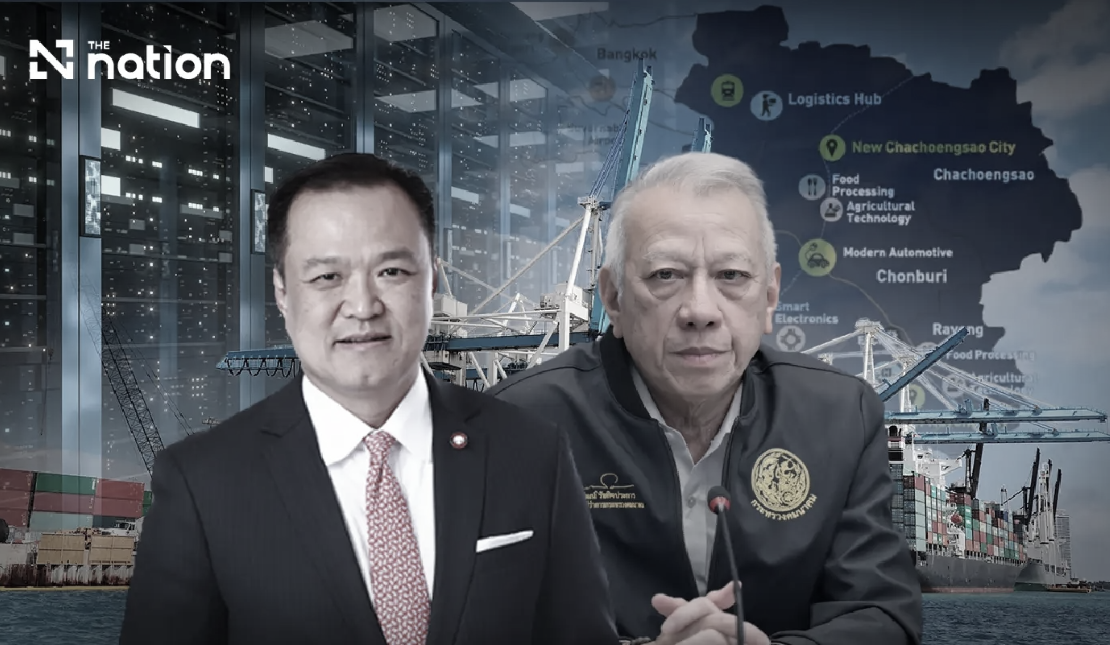
Prime Minister Anutin Charnvirakul has consolidated control over Thailand's Eastern Economic Corridor, removing Deputy Prime Minister Phiphat Ratchakitprakarn from oversight of the sprawling development zone. The Cabinet formally acknowledged the administrative change on Tuesday, with Prime Minister's Office orders dated June 15 revoking Phiphat's supervisory authority and his chairmanship of the EEC Policy Committee. This centralisation of power signals a fundamental reorientation of how Thailand intends to market and develop one of Southeast Asia's most ambitious regional investment initiatives.
The reshuffle reflects a strategic recalibration rather than simple bureaucratic reshuffling. By assuming direct leadership, Anutin positions himself as the architect of a new investment narrative for the corridor, moving away from its established identity as an industrial manufacturing hub. Government sources indicate the Prime Minister intends to present the EEC to foreign investors as a comprehensive solution to emerging global challenges, particularly food security—a priority that has gained considerable traction among international governments and multinational corporations seeking to diversify supply chains away from geopolitical hotspots.
Thailand's eastern region possesses genuine comparative advantages in the agricultural sectors Anutin seeks to promote. The area encompasses substantial livestock operations, established fisheries infrastructure, extensive agricultural lands, and horticultural production facilities. These assets have historically remained underutilised in the EEC's investment marketing strategy, which traditionally emphasised petrochemicals, automotive manufacturing, and heavy industry. By rebranding these agricultural capabilities as components of a "global food security hub," the government positions itself to capture investment from food corporations, agricultural technology firms, and sovereign wealth funds increasingly concerned about supply chain resilience.
Equally significant is the government's pivot toward data centre development, a sector that demands substantial capital investment and carries high margins for host nations. Data centres require reliable electricity supplies, sophisticated cooling infrastructure using substantial water resources, and comprehensive telecommunications networks. These operational demands necessitate coordination across Thailand's Energy Ministry, water authorities, and regional infrastructure bodies—precisely the type of integrated government approach that centralised leadership under a Prime Minister's office can facilitate more effectively than dispersed ministerial control.
The Energy Ministry is already preparing groundwork for this expansion through a new electricity tariff category, designated Type 9, specifically designed for data centre operators. This category will charge premium power rates reflecting the sector's extraordinary electricity consumption, yet the arrangement offers data centres cost-predictability and grid priority—factors increasingly attractive to multinational operators evaluating regional headquarters locations. Regional investors eyeing alternatives to congested Southeast Asian hubs like Singapore and Ho Chi Minh City may view Thailand's coordinated approach and competitive pricing as advantageous.
The underlying rationale for the EEC's repositioning stems from genuine infrastructure constraints. Thailand's eastern industrial region has encountered mounting difficulties securing adequate electricity and water supplies to support unconstrained heavy industrial expansion. Procurement costs for both utilities have escalated substantially, making traditional petrochemical and automotive manufacturing expansions economically less compelling than previously. Rather than invest heavily in duplicative infrastructure serving legacy industries, Thai policymakers recognised an opportunity to attract capital-intensive service sectors with lower physical resource demands per unit of output—though data centres, paradoxically, require enormous electricity and water quantities despite their relatively modest physical footprint.
Phiphat's apparent acquiescence to this reorganisation, according to official explanations, derived from frustration with institutional friction between the EEC Office and the Board of Investment. The two agencies had experienced persistent jurisdictional conflicts and coordination challenges that impeded project development and investor relations. Rather than preside over a bureaucratic battleground, Phiphat reportedly proposed that Anutin assume direct control, a narrative that official sources emphasise reflected pragmatic institutional management rather than political defeat. However, Phiphat's earlier public comments indicating he received no advance notice of the Cabinet orders suggested some surprise, complicating the official accounts of collegial agreement.
Government sources explicitly denied that the reshuffle connected to Phiphat's resistance to amending the long-troubled Don Mueang-Suvarnabhumi-U-Tapao high-speed rail contract. That project, conceded to Asia Era One (a CP Group-connected entity) in 2019, has languished without construction commencement as disputes persist over payment mechanisms. Phiphat had insisted on maintaining the original agreement requiring the private partner to complete construction before receiving state compensation, rejecting a "build-and-pay" model tied to construction milestones. Anutin himself apparently sided with Phiphat's conservative stance, viewing contract amendments as excessively risky. The Prime Minister's office stressed this consensus represented genuine alignment rather than a pretext for the EEC transfer.
Moreover, sources indicated Anutin had questioned Phiphat's enthusiasm for developing a Disneyland project within the EEC, seeking evidence that financial returns justified such megaproject investment. This scrutiny suggests the Prime Minister's office intends to impose stricter investment discipline on EEC developments, requiring demonstrable feasibility studies and projected return analyses before committing resources. This analytical rigour contrasts with Thailand's historical pattern of championing megaprojects based more on political ambitions than rigorous financial modelling.
For Malaysian and Southeast Asian observers, Thailand's EEC repositioning carries significant competitive implications. Thailand is explicitly positioning itself as a regional alternative for food-related investment and data centre development—sectors where Malaysia, Singapore, Indonesia, and Vietnam are simultaneously competing. The Thai government's centralised coordination of investment promotion through the Prime Minister's office represents a potentially formidable institutional arrangement. The emphasis on food security investment may particularly resonate with Middle Eastern sovereign wealth funds and Asian multinational corporations seeking to secure protein supply chains. Malaysian policymakers should note that Anutin's direct involvement signals that Bangkok intends to treat the EEC as a prestige project commanding highest-level political attention.
The timing of this repositioning also reflects regional economic realities. Global supply chain pressures, energy market volatility, and geopolitical fragmentation have made countries' investment promotion strategies increasingly consequential. Thailand's decision to reframe the EEC around food security and data infrastructure, rather than persisting with traditional heavy industry marketing, suggests Bangkok has recognised that modern investment competition occurs across multiple fronts simultaneously. Data centres, in particular, represent genuinely mobile investments—operators evaluate jurisdictions based on electricity pricing, political stability, regulatory clarity, and infrastructure reliability. Thailand's coordinated approach, with premium tariff structures and high-level political backing, positions it competitively against regional alternatives.
The EEC represents Thailand's most significant regional development initiative, encompassing Rayong, Chachoengsao, and Chonburi provinces. Its successful repositioning could substantially enhance Thailand's role in Southeast Asian economic architecture. Conversely, institutional friction or policy inconsistency could undermine investor confidence. Anutin's consolidation of control eliminates some bureaucratic obstacles while concentrating accountability for outcomes, creating both opportunity and risk. For Malaysian observers particularly concerned about regional competitiveness, Thailand's assertive repositioning warrants close scrutiny of whether the strategic reorientation successfully attracts substantial new investment or merely represents rhetorical repositioning without substance.