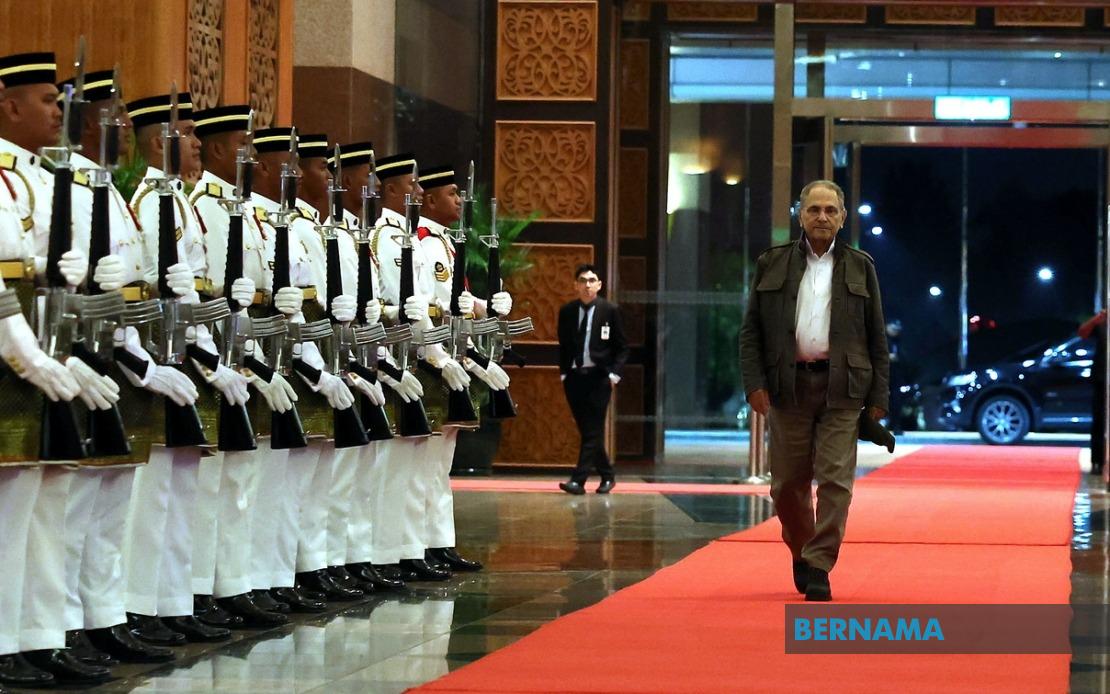
Timor-Leste President Jose Ramos-Horta departed Malaysia early on June 17 following a five-day official visit that underscored the strategic importance both nations place on bilateral cooperation and their shared vision for Southeast Asian stability. The Nobel Peace Prize laureate boarded a Batik Air flight from Kuala Lumpur International Airport's Terminal 1, concluding a visit that brought together high-level political engagement, business dialogue, and symbolic gestures of diplomatic respect.
The President's departure was marked by formal protocol befitting his status, with a static Guard of Honour comprising two officers and 26 personnel from the First Battalion Royal Ranger Regiment assembled at the Bunga Raya Complex. This ceremonial farewell reflected Malaysia's recognition of Timor-Leste's strategic position in the region and the importance of maintaining strong institutional ties between the two governments.
During his time in Malaysia, Ramos-Horta participated in a significant dialogue session on June 15 titled "A Changing World, Enduring Values," where he characterised bilateral relations as "exceptionally good." This assessment carried particular weight given Timor-Leste's relatively recent emergence as an independent nation and its ongoing integration into regional frameworks. The President's public endorsement of Malaysia's achievements across security, democratic governance, and economic development signalled a desire to position the relationship as one built on admiration and shared institutional values rather than mere transactional interests.
A central theme throughout the visit was Malaysia's historical support for Timor-Leste dating back decades. Ramos-Horta acknowledged Malaysia's pivotal role in the 1999 peacekeeping mission that stabilised the newly independent nation, demonstrating how security cooperation has formed the bedrock of bilateral relations. He also credited Malaysia's backing for Timor-Leste's accession to ASEAN membership, officially achieved on October 26, 2025, when the Southeast Asian nation became the bloc's 11th member. For Timor-Leste, this moment represented decades of diplomatic effort and regional integration, making Malaysia's support during the chairmanship year particularly significant.
Looking forward, Ramos-Horta expressed confidence in Timor-Leste's capacity to host the ASEAN Summit in 2029, signalling accelerated infrastructure development and demonstrating the country's commitment to meeting the rigorous standards required for such a major regional gathering. This timeline creates urgency for investment and technical cooperation, areas where Malaysia's experience hosting multiple ASEAN summits could prove invaluable for knowledge transfer and best practice sharing.
Economic deepening emerged as a priority theme during Prime Minister Datuk Seri Anwar Ibrahim's luncheon reception at Seri Perdana Complex. Both leaders discussed expanding cooperation across multiple sectors including trade, investment, human capital development, education, and technical training. These discussions reflected an understanding that political goodwill must translate into concrete economic mechanisms to sustain long-term partnership. The identification of human capital development as a key pillar suggests both nations recognise that Timor-Leste's developmental trajectory depends partly on institutional capacity-building and knowledge sharing with more established neighbours.
The current trade relationship, however, reveals substantial asymmetry. Bilateral trade in 2024 reached only USD18.72 million, with Malaysian exports at USD18.37 million overwhelmingly dominating the exchange, while Timor-Leste's imports from Malaysia totalled merely USD0.35 million. This imbalance reflects Timor-Leste's limited manufacturing base and export capacity, a reality that makes Malaysian investment in the newer nation's infrastructure sector particularly appealing. The disparity also underscores why presidential-level visits emphasising investment opportunities carry genuine strategic weight for Timor-Leste's economic diversification goals.
Ramos-Horta's explicit invitation to Malaysian investors highlighted several competitive advantages Timor-Leste possesses, particularly its low sovereign debt levels and robust wealth fund, factors that distinguish it from many developing nations competing for foreign direct investment. Access to multilateral financing institutions further strengthens the investment case, suggesting that risk-averse Malaysian corporations could find stable platforms for regional infrastructure expansion. This positioning attempts to transform perceptions of Timor-Leste from a fragile post-conflict society into an emerging market opportunity, though significant institutional and developmental challenges remain beneath the diplomatic messaging.
The visit's timing carries additional strategic significance within broader Southeast Asian dynamics. Timor-Leste's full integration into ASEAN represents a long-delayed completion of regional territorial coverage and brings the bloc closer to Australia and the Indian Ocean, subtly reshaping the bloc's geopolitical orientation. For Malaysia, engagement with the newest ASEAN member offers opportunities to shape institutional norms and development patterns while consolidating influence during this critical period of Timor-Leste's regional socialisation. Both nations stand to benefit from this deepening relationship, though success will depend on translating ceremonial goodwill into sustained institutional cooperation and measurable economic results that improve conditions for ordinary citizens in both countries.