Malaysia's Deputy Prime Minister Datuk Seri Dr Ahmad Zahid Hamidi has emphasised that the Tokoh Maal Hijrah awards present a powerful example for the nation's Muslim community to emulate, urging believers to deepen their commitment to learning, social service and the broader advancement of Islamic civilisation. The annual recognition programme, held at Masjid Putra in Putrajaya, celebrates individuals who embody the spiritual and intellectual values central to Islamic heritage and contemporary Muslim identity.
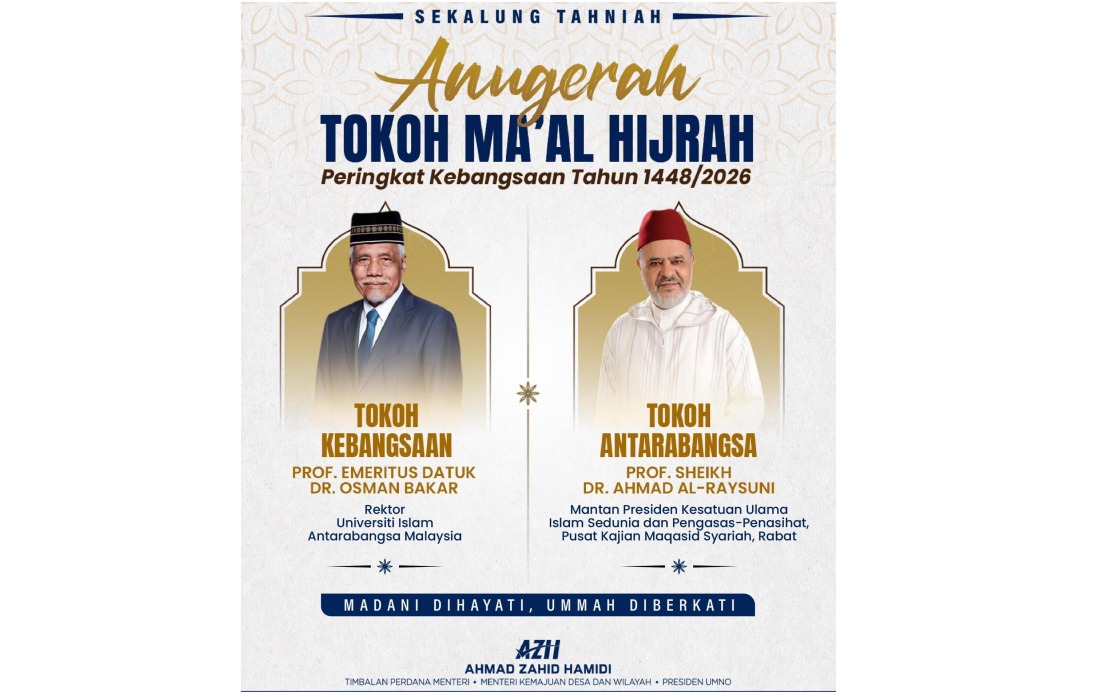
This year's honourees represent distinguished contributions across different spheres of Islamic scholarship and community leadership. Prof Emeritus Datuk Dr Osman Bakar received the National Tokoh Maal Hijrah Award for his decades of academic work and intellectual leadership within Malaysia, whilst Prof Sheikh Dr Ahmad Al-Raysuni, a prominent Islamic jurisprudence specialist from Morocco, was recognised with the International Tokoh Maal Hijrah Award. Their selection underscores the programme's dual focus on honouring local excellence whilst acknowledging the transnational character of contemporary Islamic thought and practice.
Ahmad Zahid highlighted that the recipients' recognition stemmed from their tangible impact in strengthening Muslim communities, elevating scholarly discourse, and disseminating Islamic principles that emphasise compassion, practical wisdom and measurable social benefit. He stressed that their achievements should catalyse broader shifts in how Malaysia's Muslim population approaches intellectual development and civic participation, framing knowledge-seeking and community engagement as religious obligations rather than optional pursuits. This framing aligns with traditional Islamic teaching that positions education and social service as core pillars of faith practice.
The ceremony itself was presided over by Sultan Nazrin Shah, the Sultan of Perak, who formally presented the laureates with cash prizes, commemorative trophies and certificates of commendation. This institutional recognition, coming from the highest levels of Malaysia's constitutional hierarchy, signals the government's commitment to celebrating and promoting exemplary Islamic scholarship and leadership. The formal occasion at a national mosque underscores the symbolic weight attached to these awards within Malaysia's public discourse on Islam and national identity.
Deputy Prime Minister Datuk Seri Fadillah Yusof also seized the occasion to reinforce the awards' broader significance, arguing that the recognition programme speaks to universal Malaysian values beyond religious boundaries. He characterised the awards as an opportunity for all citizens to reflect on principles of service and contribution to the nation's future. This inclusive framing attempts to position the Tokoh Maal Hijrah initiative as embodying national values whilst maintaining its specific Islamic theological anchoring, a delicate balance that reflects Malaysia's constitutional commitment to Islam within a plural society.
Fadillah drew explicit connections between the Islamic concept of hijrah—Prophet Muhammad's migration from Mecca to Medina—and contemporary nation-building efforts. Rather than treating hijrah as merely a historical religious event, he presented it as an enduring philosophical template encompassing sacrifice, collective solidarity, steadfastness and purposeful change. This interpretive approach resonates within contemporary Islamic reformist discourse, which emphasises hijrah's relevance to modern challenges of social cohesion, ethical development and sustainable progress. For Malaysian audiences, the framing positions Islamic historical memory as directly applicable to contemporary national challenges.
The Deputy Prime Minister's rhetoric emphasised that the spirit of hijrah should animate efforts to construct a society simultaneously progressive, materially prosperous and grounded in ethical values. This tripartite formulation reflects ongoing debates within Malaysian politics about balancing modernisation with moral anchoring, a tension particularly acute in a Muslim-majority nation navigating rapid technological and social change. His call for unified effort toward strengthening religious commitment, deepening faith-based ethical practice and increasing charitable acts suggests that public policymakers view religious inspiration and institutional reinforcement as complementary to more conventional governance mechanisms.
The selection of both a Malaysian and an international recipient carries strategic implications for how Malaysia positions itself within global Islamic intellectual networks. By honouring Prof Ahmad Al-Raysuni, whose scholarly work on Islamic jurisprudence enjoys international standing, Malaysia signals its ambition to remain relevant within transnational conversations about Islam's relationship to contemporary governance, ethics and social development. This international dimension may also reflect Malaysia's broader foreign policy interest in positioning itself as a bridge between Islamic-majority nations and diverse global communities, leveraging cultural and religious soft power.
The awards ceremony itself represents one of multiple mechanisms through which the Malaysian state engages with Islam as both a religious tradition and a national identity pillar. Unlike some neighbouring countries with different constitutional arrangements, Malaysia's federal structure assigns Islam a constitutionally privileged position alongside commitment to pluralism and minority religious rights. Annual awards programmes, mosque-based ceremonial functions and ministerial endorsements constitute a sophisticated apparatus for affirming Islamic values within democratic governance frameworks whilst maintaining space for other faith traditions.
For Malaysia's broader Muslim community, the awards implicitly establish benchmarks for exemplary conduct and contribution. By celebrating scholarly achievement, community empowerment and intellectual rigour, the state articulates particular visions of what constitutes valuable Islamic practice in the contemporary context. This matters because it shapes public understanding of how religious commitment translates into social action and national contribution. The emphasis on knowledge-seeking aligns with educational policy objectives whilst the focus on community service reinforces volunteering and civil society participation.
The institutional elevation of these awards, involving the Sultan and multiple cabinet ministers, reflects how seriously Malaysia's political leadership takes the symbolic management of national Islamic identity. Rather than leaving religious matters to clerical authorities alone, state officials actively participate in recognising and promoting particular expressions of Islamic learning and practice. This engagement reflects historical patterns dating to Malaysia's independence, when political leaders recognised that managing national identity around Islam required active state involvement in promoting particular interpretations whilst maintaining constitutional protections for religious minorities.
For the broader Southeast Asian context, Malaysia's approach to celebrating Islamic intellectual and community leadership through state-sponsored awards programmes offers an instructive example of how Muslim-majority democracies can maintain religious-national identity connections whilst preserving institutional pluralism. The specific recognition of international Islamic scholarship also positions Malaysia within broader Muslim-world networks, affirming that Islamic expertise and excellence transcend national boundaries even as the awards programme itself celebrates national contributions and national values.