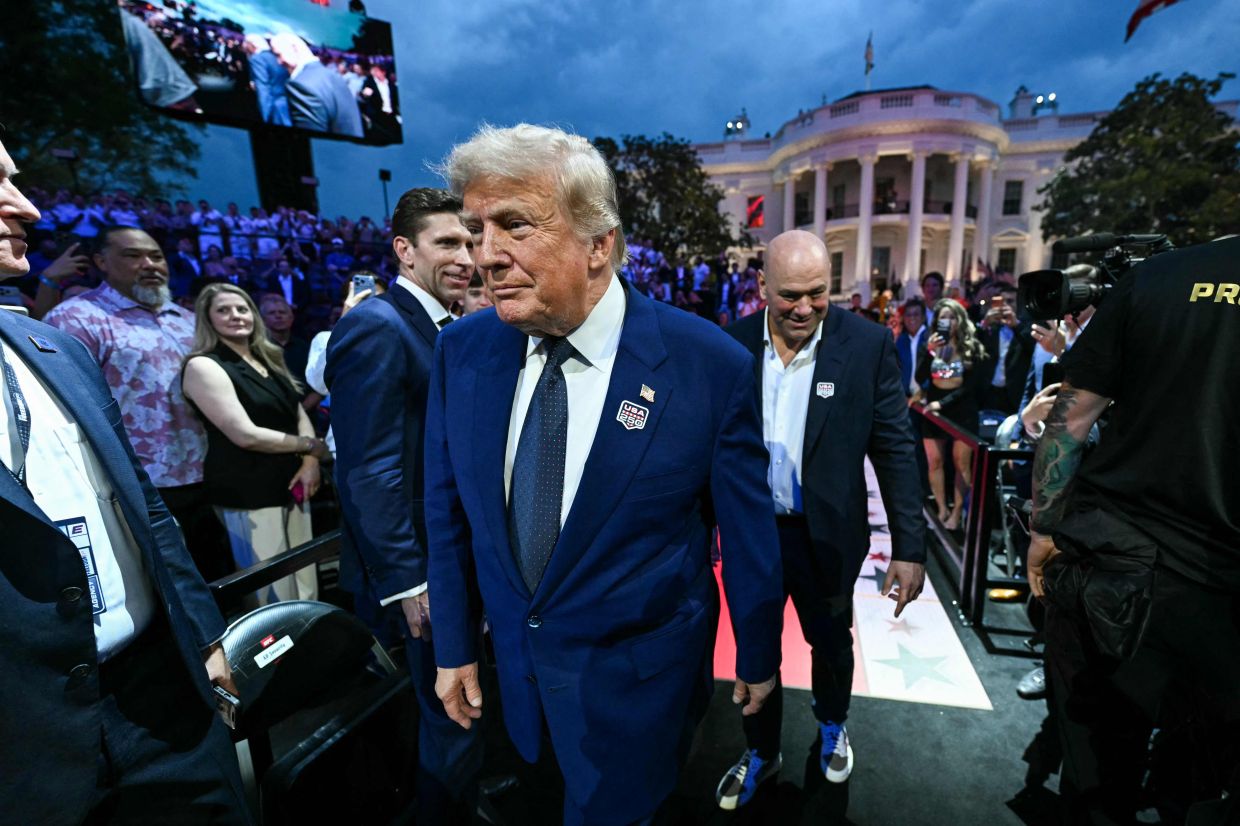
Donald Trump rang in his 80th birthday by bringing the Ultimate Fighting Championship to the grounds of the White House, a spectacle that eclipsed the typical festivities associated with presidential celebrations and reflected his unconventional approach to national events. The Sunday evening gathering on the South Lawn represented a marked departure from traditional White House events, setting aside the customary Easter Egg Roll and Congressional Picnic format that has defined the venue for generations.
The UFC event, operated by TKO Group Holdings Inc., commenced just before 8:30 pm as Trump and UFC President Dana White made their way through the White House to the arena. A nearly 100-foot-tall structure called the "Claw" dominated the landscape, dwarfing even the White House itself and accommodating 4,300 spectators in seated areas, while an additional 120,000 individuals gathered on the nearby Ellipse to watch on screens using free lottery-distributed tickets. The construction of this temporary venue required coordination across more than seven federal agencies, which collectively allocated substantial resources and personnel to execute the event.
The timing of the event positioned it as an opening salvo in Trump's vision for celebrating the nation's 250th anniversary, a commemoration that includes a commemorative gold coin bearing his image, an expansive fair on the National Mall, and plans for an IndyCar race through Washington DC streets in August. This framing of the UFC event within a broader patriotic narrative represents an effort to situate commercial entertainment within the context of national celebration, though critics have questioned whether a combat sport belongs in such a setting.
Notable attendees included Meta Platforms Inc. CEO Mark Zuckerberg and Paramount Skydance Corp. CEO David Ellison, alongside Treasury Secretary Scott Bessent and Trump family members, underscoring the event's significance within political and business circles. The presence of military servicemembers in the audience, coupled with coverage that cut to watch parties at military bases including those in Okinawa, Japan, extended the event's reach to American forces stationed globally. Joe Rogan, the podcast host whose audience skewed toward younger male voters who supported Trump in the 2024 election, provided commentary throughout the matches.
The UFC organisation spent over US$60 million to stage the event, with the White House confirming that the company covered all costs and managed sponsorship arrangements independently. Despite this assertion of financial separation, court filings revealed the substantial public resource commitment required to bring the spectacle to fruition. Sponsors included cryptocurrency platform Crypto.com and Dodge's Ram truck brand, while World Liberty Financial, identified as a Trump-family venture, contributed an additional US$250,000 bonus pool for the top two fighters.
The event did not proceed without controversy and legal challenge. The Public Integrity Project filed a lawsuit characterising the gathering as a "volcano of corruption," and polling data revealed public scepticism about the appropriateness of the venue and occasion. A YouGov survey released on June 5 indicated that 51 percent of Americans disapproved of the White House fight, while only 27 percent expressed approval, suggesting a meaningful gap between the administration's enthusiasm and broader public sentiment.
The UFC's core demographic—young male audiences who formed a crucial voting bloc in the 2024 election—made the event strategically significant for the Trump administration. This alignment between entertainment and electoral strategy became explicit through partnership agreements signed by the State Department and Federal Bureau of Investigation with the UFC, formalising the relationship between government institutions and the sporting organisation.
Preparations extended beyond the arena itself into Washington's historic landscape. The news conference announcing the event took place at the Lincoln Memorial, where participating fighters engaged in the traditional antagonistic rhetoric characteristic of combat sports promotion. Individual fighters framed their participation within the symbolic weight of the occasion, with Michael Chandler emphasising the significance of fighting on the White House lawn for America's 250th birthday celebrations.
The operational demands were extensive, with locker rooms established on White House grounds, including the Indian Treaty Room, a space ordinarily reserved for official state functions. This repurposing of historically significant spaces underscored the event's scale and the administrative commitment required to realise Trump's vision. The South Lawn, typically hosting more ceremonial gatherings, was transformed into a combat arena that towered above the building behind it.
Trump's comments about potentially retaining the structure permanently revealed the symbolic significance he attributed to the installation. In a June 2 TikTok video, he compared the arena favourably to the Eiffel Tower, suggesting permanence might be desirable. This rhetorical flourish, subsequently characterised as joking, contrasted with official court filings indicating the structure would be disassembled beginning Monday at 10 am, immediately following Trump's departure to France for Group of Seven leadership meetings.
The event occurs within the context of Trump's broader relationship with combat sports and his cultivation of younger male voters who comprise the UFC's primary audience. By hosting the organisation at the presidential residence and integrating it into national commemorative activities, the administration signalled alignment with entertainment preferences of a key demographic while simultaneously expanding the boundaries of what events are considered appropriate for presidential venues.
For Malaysian and Southeast Asian observers, the event illustrates how political leaders leverage popular entertainment to build coalitions and project power. The integration of private corporate interests with state resources, the use of military personnel as supporting players in civilian entertainment, and the strategic use of venues typically reserved for diplomatic functions reflect broader trends in how contemporary political leaders blur boundaries between governance and spectacle. The public disapproval evident in polling suggests that such approaches carry political risks, even among domestic audiences.