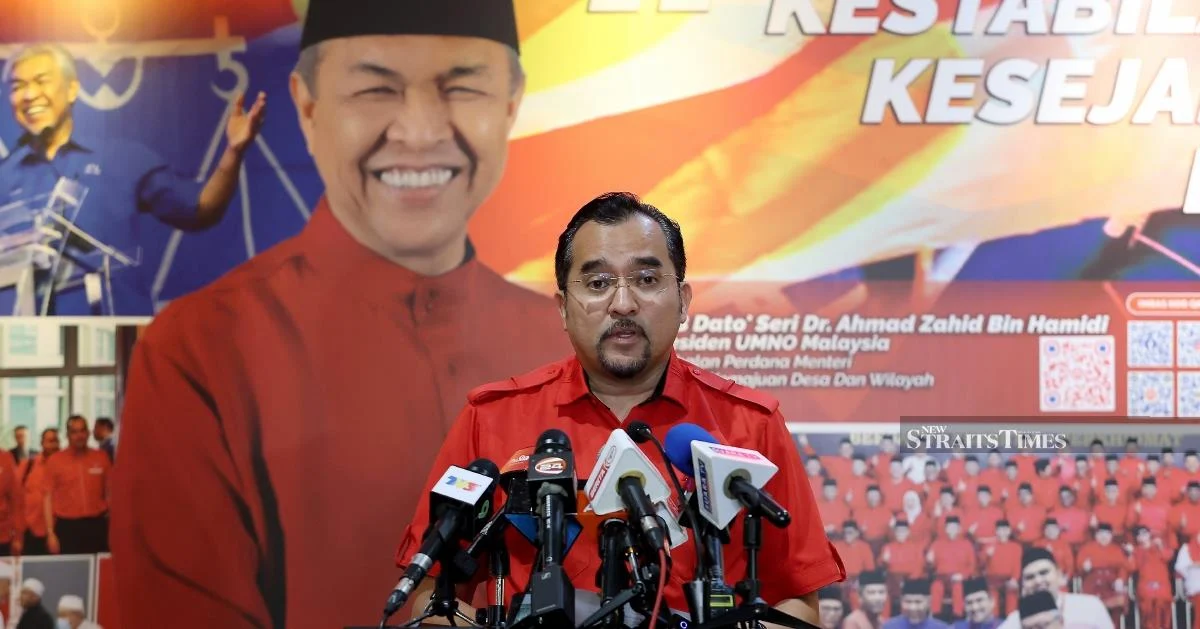
Umno's leadership has committed to maintaining a high standard of political discourse during the forthcoming state elections in Johor and Negri Sembilan, with party secretary-general Datuk Dr Asyraf Wajdi Dusuki declaring that campaign efforts will concentrate on tangible policy offerings and their potential to improve residents' lives rather than engaging in character assassination or negative personal attacks.
The commitment represents a notable positioning for the ruling party as it prepares for electoral contests in two significant peninsular states. Johor, long considered an Umno stronghold, holds particular importance in Malaysia's political landscape due to its size, economic contribution, and historical alignment with the party's fortunes. Negri Sembilan, meanwhile, presents a different electoral equation with competing regional interests and shifting demographic patterns that have made recent state politics increasingly competitive.
Datuk Dr Asyraf Wajdi Dusuki's declaration appears calculated to contrast Umno's approach with broader political trends in Malaysia, where campaign cycles have increasingly featured aggressive rhetoric, personal allegations, and attacks on opponents' character rather than substantive policy debate. By explicitly rejecting mudslinging tactics, Umno signals an intention to reclaim the moral high ground and appeal to voters fatigued by adversarial politics, potentially positioning the party as the responsible alternative focused on governance rather than sensationalism.
The substance of such campaigns becomes particularly relevant given Malaysia's varied electoral contexts. State-level elections provide opportunities for parties to showcase localized policy initiatives—infrastructure development, education improvements, healthcare provision, and economic opportunities—that resonate directly with voter experiences. In Johor, where industrial development and agricultural interests coexist, and in Negri Sembilan, where manufacturing and tourism sectors play significant roles, targeted policy messaging can effectively address constituency-specific concerns.
Umno's emphasis on policy-driven campaigns also reflects recognition that Malaysian voters increasingly demand substantive engagement with real-world governance challenges. Rising cost of living, employment opportunities, and service delivery remain consistent voter priorities across states. By committing to discuss how party proposals address these tangible concerns, Umno attempts to demonstrate that its electoral message rests on credible plans rather than political theatrics or personal invective against opponents.
The timing of such pronouncements carries strategic weight. Election cycles in Malaysia often witness escalating intensity in campaign rhetoric as polling day approaches, with parties tempted to resort to increasingly provocative messaging. Early declarations establishing campaign tone effectively set expectations and create accountability mechanisms—parties that subsequently abandon stated principles risk credibility damage. Umno's pre-campaign commitment thus functions as both ethical positioning and strategic anchoring.
For Malaysian voters and observers in Southeast Asia monitoring Malaysia's democratic health, such commitments matter considerably. Political discourse quality directly influences public trust in institutions, civic participation levels, and democratic resilience. When major parties voluntarily commit to substantive engagement, they collectively elevate standards that benefit entire political systems. Conversely, when such commitments prove hollow, they contribute to voter cynicism and democratic disengagement.
The regional implications deserve consideration as well. Southeast Asian democracies frequently struggle with balancing competitive electoral politics against maintenance of institutional integrity and social cohesion. Malaysia's approach—particularly whether major parties actually honor commitments to issue-focused campaigns—provides observable lessons for comparable states navigating similar tensions between robust democratic competition and responsible political behaviour.
Umno's historical positioning as Malaysia's dominant political force means its campaign choices carry outsized influence on broader political culture. When the party's secretary-general publicly commits to elevated campaign standards, this shapes expectations not only among Umno's own candidates and members but also among opposition parties and the broader electorate. It creates implicit competitive pressure for other parties to reciprocate or risk appearing unnecessarily negative by contrast.
Implementing such commitments operationally presents genuine challenges. Individual candidates, grassroots activists, and party supporters often generate campaign messaging independently, making centralized control difficult. Digital media platforms amplify unfiltered messaging from party supporters whose statements party leadership cannot easily monitor or suppress. Distinguishing between legitimate policy criticism and personal mudslinging sometimes involves judgment calls where reasonable observers might disagree. Nevertheless, setting clear organizational culture and training requirements can meaningfully influence campaign tone throughout party structures.
The substantive focus Datuk Dr Asyraf Wajdi Dusuki advocates should encompass not merely generic pledges but specific, measurable, implementable proposals addressing each state's particular circumstances. Johor residents expect engagement with port development, federal-state economic coordination, and the state's role in national economic corridors. Negri Sembilan voters warrant serious discussion of state infrastructure, industrial diversification, and administrative efficiency. Effective policy-focused campaigns deliver differentiated messages reflecting these distinct contexts.
Looking ahead, observers will monitor whether Umno's actual campaign conduct aligns with leadership declarations. The party's performance in maintaining issue-focused messaging under electoral pressure will influence broader Malaysian political standards and shape how future state campaigns unfold across the nation.


