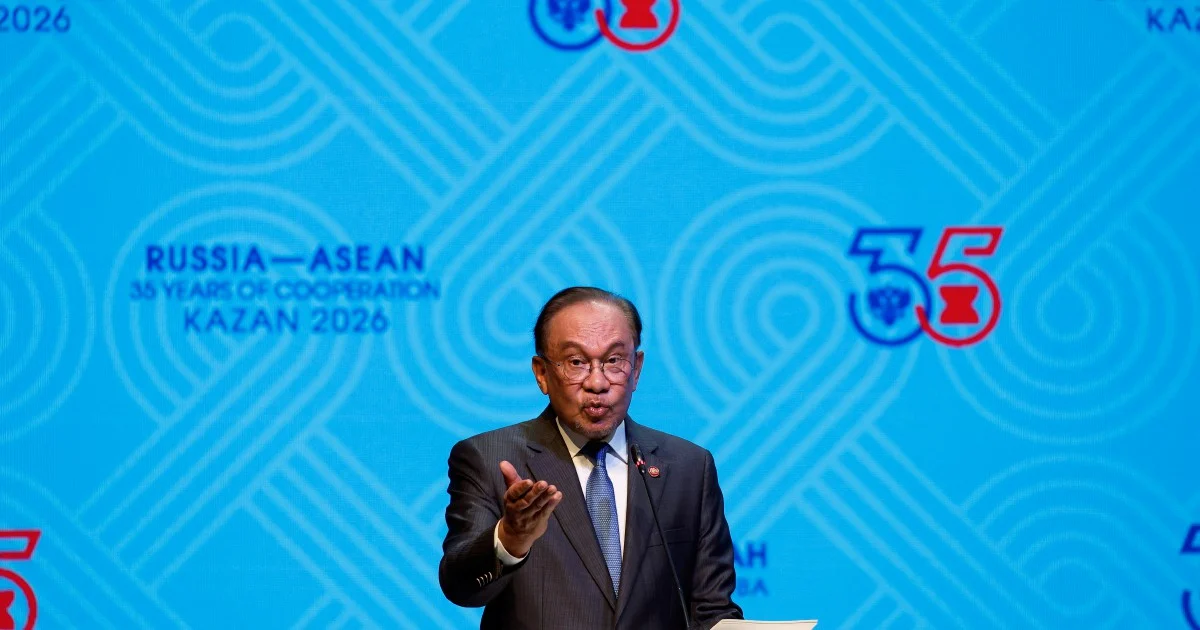
Prime Minister Datuk Seri Anwar Ibrahim has expressed cautious optimism about the completion of the Asean-Russia Strategic Programme on Trade and Investment Cooperation 2026-2035, characterising the achievement as a meaningful step forward for regional economic engagement. Speaking in Kazan, Anwar underscored that while the finalisation of this framework represents a significant milestone, translating the roadmap's ambitious goals into tangible commercial benefits will require careful attention to the broader structural conditions that enable such partnerships to flourish.
The strategic programme represents the latest attempt by the Asean bloc to formalise its economic relationship with Russia during a period when geopolitical tensions and international sanctions have complicated Moscow's trade relationships globally. By establishing a decade-long cooperation framework, both Asean and Russia are signalling their commitment to deepening commercial and investment ties despite the challenging external environment. For Malaysia, which holds considerable influence within Asean and maintains its own significant trading relationships, the programme offers potential avenues for enhancing regional economic resilience through diversified partnerships.
Anwar's remarks reflect a pragmatic understanding of what such frameworks can and cannot accomplish. While the completion of the 2026-2035 roadmap provides legal and institutional scaffolding for bilateral and multilateral trade expansion, success ultimately depends on whether member nations can create the practical conditions necessary for business to thrive. This includes addressing regulatory harmonisation, improving logistics infrastructure, reducing tariff barriers, and establishing transparent mechanisms for dispute resolution that foreign investors require before committing substantial capital to new markets.
The Asean region has long sought to balance its relationships between major powers while pursuing its own economic interests. Russia, despite facing Western sanctions, remains a significant energy supplier and potential market for the bloc's manufacturing and agricultural exports. For Malaysia specifically, the framework opens possibilities for expanding palm oil trade, processing industries, and technology partnerships, though realising these opportunities will require coordinated efforts between government agencies and the private sector.
The timing of this programme's finalisation carries particular significance given the evolving geopolitical landscape in Southeast Asia. As regional nations navigate relationships with the United States, China, and other major powers, maintaining constructive engagement with Russia demonstrates Asean's commitment to non-alignment and inclusive regionalism. This positioning has become increasingly important as countries seek to avoid being forced into narrow alliances while maintaining space for independent economic decision-making.
However, Anwar's emphasis on the need for an enabling environment highlights realistic challenges that lie ahead. Sanctions regimes, currency volatility, and political uncertainty can all undermine even well-designed trade frameworks. Additionally, Asean members have varying levels of capacity to take advantage of such opportunities, meaning that implementation may proceed unevenly across the region. Malaysia, as a relatively developed economy with strong institutional capacity, stands to benefit more directly than some neighbours, particularly if it can position itself as a logistics and services hub for Asean-Russia commerce.
The road map's formulation reflects months of negotiation between Asean's economic officials and their Russian counterparts. Rather than attempting to impose uniform requirements across all member states, the framework appears designed with sufficient flexibility to accommodate different national circumstances and capacities. This approach has proven more sustainable for Asean initiatives historically, though it can sometimes result in diluted impact if commitment levels vary significantly among participants.
From an investment perspective, the 2026-2035 horizon gives companies reasonable certainty for long-term planning. Businesses require predictability regarding regulatory frameworks and market access conditions before investing in new operations or supply chains. By establishing this ten-year programme, both sides are attempting to provide such certainty, though geopolitical developments could always supersede contractual commitments. Malaysian firms with existing expertise in emerging market operations may find particular advantages in serving as intermediaries or establishing operations that can serve both Asean and Russian markets.
The energy sector represents one of the most obvious areas for deepened cooperation, given Russia's substantial hydrocarbon reserves and Asia's growing energy requirements. However, the programme appears designed to encompass broader categories including manufacturing, agricultural products, and services. For Malaysia, sectors such as palm oil processing, petrochemicals, and digital services could all feature prominently in bilateral engagement with Russian counterparts.
Anwar's measured comments suggest the Malaysian government views this framework as one component of a broader strategy to deepen Asean's economic partnerships globally. Rather than representing a wholesale pivot in Malaysian or Asean foreign economic policy, the programme complements existing relationships while creating incremental opportunities. This gradualist approach reflects the complex balancing act that regional nations must perform when engaging with countries operating under significant international constraints.
The real test of the Asean-Russia Strategic Programme will come in implementation. Establishing the institutional mechanisms for cooperation, developing sector-specific initiatives, and facilitating actual business transactions between companies across the two regions will require sustained effort from governments and private sector actors alike. Malaysia, leveraging its position within Asean and its established business networks, has potential to play a constructive role in advancing these objectives while ensuring that engagement serves the economic interests of Malaysian enterprises and workers.
Moving forward, success will likely depend on how actively member nations pursue the framework's objectives and whether unforeseen geopolitical developments allow the commercial relationships to develop as envisaged. For Malaysia and the broader Asean region, the programme represents an important declaration of intent to maintain economic engagement with Russia, demonstrating that regional nations retain agency in pursuing their own commercial interests regardless of external pressures. Whether this translates into substantial new trade flows and investment remains to be seen, but establishing such frameworks is an essential prerequisite for any meaningful economic deepening.